Introduction
The United Nations Framework Convention on Climate Change (UNFCCC) is one of the principal pillars of global climate governance through which international cooperation on climate change is institutionalised. As the foundational framework for collective climate action, it laid the legal and institutional basis for multilateral responses to climate change. By providing a permanent negotiation forum, establishing common principles, and enabling collective decision-making through mechanisms such as the Conference of Parties (COP), the UNFCCC has fundamentally shaped how nations respond to rising greenhouse gas (GHG) emissions.
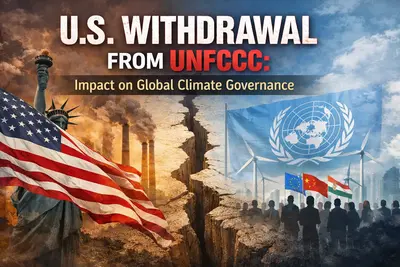
Against this backdrop, the recent decision of the United States to withdraw from the UNFCCC represents an unprecedented development in climate diplomacy. No country has ever exited this core climate treaty before. While the long-term implications remain uncertain, the move raises serious questions about the future of multilateral climate cooperation, the credibility of global commitments, and the resilience of UN-based climate institutions.
Overview of the UNFCCC
The UNFCCC is an international environmental treaty adopted at the 1992 Earth Summit in Rio de Janeiro, aimed at facilitating collective action to address climate change.
Its primary objective is to:
“stabilise greenhouse gas concentrations in the atmosphere at a level that would prevent dangerous anthropogenic interference with the climate system.”
Crucially, the UNFCCC itself does not impose binding emission reduction targets. Instead, it provides the institutional framework within which countries negotiate, cooperate, and progressively develop legally binding or voluntary climate agreements.
Core Principles of the UNFCCC
Global climate negotiations under the UNFCCC are guided by foundational principles:
- Common But Differentiated Responsibilities and Respective Capabilities (CBDR-RC)
- Equity
- Precautionary Principle
- Sustainable Development
- Historical responsibility of developed countries
These principles recognise unequal historical contributions to climate change and differing national capacities. They form the legal and moral basis for differentiated obligations under international climate agreements.
Major Agreements under the UNFCCC
The UNFCCC functions as a parent treaty for three major climate instruments:
1. UNFCCC (1992)
- Framework convention
- Establishes principles and processes
- No binding emission targets
2. Kyoto Protocol (1997)
- Binding emission reduction targets for developed countries
- Introduced market-based mechanisms:
- Clean Development Mechanism (CDM)
- Joint Implementation (JI)
- Emissions Trading
3. Paris Agreement (2015)
- Legally binding procedural obligations
- Voluntary Nationally Determined Contributions (NDCs)
- Long-term goal: limit global warming to well below 2°C, preferably 1.5°C
Institutional Structure of the UNFCCC
The UNFCCC operates through a multi-tiered institutional framework:
- Conference of Parties (COP): Supreme decision-making body meeting annually
- Subsidiary Bodies:
- SBSTA (Scientific and Technological Advice)
- SBI (Implementation)
- UNFCCC Secretariat: Located in Bonn, Germany
- Financial Mechanisms:
- Green Climate Fund (GCF)
- Global Environment Facility (GEF)
- Adaptation Fund
Membership and India’s Role
The UNFCCC has near-universal membership, with 197 Parties (196 countries and the European Union), lending legitimacy and inclusiveness to climate negotiations.
India and the UNFCCC
India ratified the UNFCCC in 1993 and is a party to both the Kyoto Protocol and the Paris Agreement. It has consistently advocated:
- CBDR-RC
- Climate justice
- Predictable climate finance
- Technology transfer and capacity building
India has also used the COP platform to advance initiatives such as the International Solar Alliance (ISA), LiFE (Lifestyle for Environment), and its net-zero target by 2070, positioning itself as a bridge between development and climate ambition.
The United States and the UNFCCC
The US ratified the UNFCCC in 1992. However, under the previous administration, it has withdrawn from the agreement making this the first historic occurrence. This decision has ramifications for the principle of Universality and raises many issues, including:
- The fragmentation of climate change efforts worldwide.
- A lack of leadership in the fight against climate change;
- Less financial and diplomatic support;
UNFCCC Reports
The UNFCCC does not publish global ranking indices. Instead, it releases governance and transparency-oriented reports, including:
- National Greenhouse Gas Inventory Reports
- Biennial Transparency Reports (BTRs)
- Biennial Update Reports (BURs)
- NDC Synthesis Reports
- Global Stocktake (GST) Reports
- Adaptation Communications
Scientific assessment reports (e.g., AR6) are produced by the IPCC, not the UNFCCC.
UNFCCC & United Nations
The UNFCCC is a treaty within the UN system, reporting to the UN General Assembly. While its Secretariat functions independently, it follows UN norms and collaborates with:
- UNDP (finance and capacity building)
- UNEP (science-policy coordination)
- WMO (climate science)
- IPCC (scientific assessments)
Reduced participation weakens UN-led multilateral climate governance.
Context and Drivers of the U.S. Withdrawal
The U.S. withdrawal must be seen within a broader retreat from multilateralism. The U.S. government announced its exit from 66 international organisations, citing misalignment with national interests. This follows withdrawal from the Paris Agreement and the absence of a high-level U.S. delegation at COP30 in Brazil.
Politically, the move was framed around:
- National sovereignty
- Skepticism toward multilateral institutions
- Preference for domestic and bilateral approaches
This reflects a broader ideological preference for unilateral decision-making over collective global governance.
Impact on the UNFCCC and the United Nations
The absence of the U.S.—a major historical emitter and funder—reduces representativeness in climate negotiations and may create funding, scientific, and diplomatic gaps. It also shifts agenda-setting influence toward actors such as the EU, China, and India.
For the UN system, the withdrawal undermines inclusive multilateralism while creating a paradox where political disengagement coexists with residual legal and financial obligations.
Broader Impacts on Global Climate Action
The absence of the United States as one of the largest historical greenhouse gas emitting countries results in a decreased representation of the U.S. in climate negotiations, especially with regard to how each country should participate in the mitigation of greenhouse gases.
The withdrawal of the United States from the UNFCCC results in the loss of the United States’ ability to provide both financial and technical support to the climate process, thereby creating funding gaps, weakening the technical basis on which the climate agreements are based, and reducing the diplomatic momentum with which countries are moving forward in the climate negotiations.
The lack of leadership may result in power dynamics that are altered in favour of other major players on the global stage (i.e. the European Union, China and India) to a greater extent and provide these parties with a larger role in setting agendas.
Impact on multilateralism
In regard to Climate Finance and Technology Transfer, the lack of U.S. involvement will impact both the predictability and availability of Climate Finance, particularly with regard to the Global South, where the financing gap continues to be extremely significant, affecting both Adaptation and Mitigation efforts.
The limited participation in climate bodies/dispersal of Climate Finance mechanisms will also:
- Delay the deployment of Green Technology
- Limit the collective Research and Development of Green Technology
- Hinder the coordination of establishing standards, pathways for Innovation, and Long-Term Planning regarding Investment Strategy.
The net effect is likely to have the greatest impact on Developing Nations that need the support of Multilateral Platforms to access Technology and Build Capacity.
Critical Analysis
The withdrawal raises fundamental questions:
- Will it trigger reform or fragment climate governance?
- Can alternative coalitions replace the legitimacy and scale of the UNFCCC?
- How can global cooperation balance sovereignty with collective action?
Conclusion
The U.S. withdrawal from the UNFCCC marks a symbolic rupture in global climate diplomacy, challenging assumptions about leadership and responsibility. While the UNFCCC will endure, its effectiveness will depend on whether remaining actors can sustain momentum and uphold equity.
Ultimately, climate change remains a collective challenge, demanding cooperation beyond shifting geopolitical alignments.
Frequently Asked Questions (FAQs)
The UN Framework Convention on Climate Change (UNFCCC) is the primary global treaty for addressing climate change. It provides the institutional framework for climate negotiations, transparency, and cooperation, forming the basis for agreements like the Kyoto Protocol and the Paris Agreement.
The U.S. withdrawal is significant because it is the first country to exit the UNFCCC, weakening its near-universal membership. As a major historical emitter and funder, U.S. disengagement affects climate finance, leadership, and the credibility of multilateral climate governance.
U.S. withdrawal and its absence from COP30 in Brazil reduced diplomatic momentum in negotiations, especially on contentious issues like fossil fuel phase-out and climate finance. It also shifted greater leadership responsibility toward other actors such as the EU, China, and emerging economies.
No. The UNFCCC does not release ranking indices. It publishes governance and transparency reports such as National GHG Inventories, NDC Synthesis Reports, and Global Stocktake reports. Indices like CCPI or EPI are released by independent institutions.
For developing countries, U.S. disengagement may reduce the availability of climate finance and technology transfer. However, platforms like the UNFCCC remain crucial for countries like India to advocate climate justice, CBDR-RC, and developmental equity.