indian constitution

Articles 31A, 31B, and 31C

Articles 31A, 31B, and 31C: Balancing Property Rights, Socialism, and Judicial Review in India

Introduction “The fundamental rights must harmonize with the directive principles — for liberty without equality can be hollow, and property without justice can be tyranny.”— Jawaharlal Nehru, during debates on the First Constitutional Amendment, 1951 When enacted, the Indian Constitution gave the Right to Property as a Fundamental Right, under Articles 19(1)(f) and 31, ensuring […]

Articles 31A, 31B, and 31C: Balancing Property Rights, Socialism, and Judicial Review in India Read More »

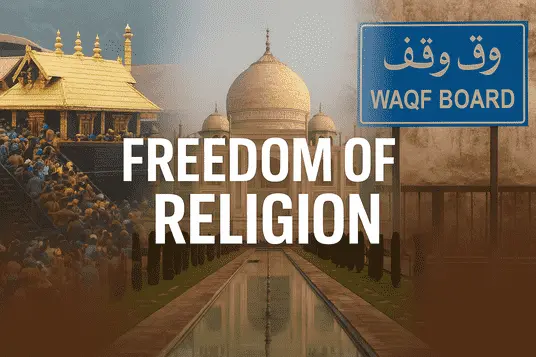
Freedom of Religion

Freedom of Religion in India: Sabarimala, Waqf Board, and Constitutional Insights

In a country of a thousand different faiths, the Constitution of India serves as the only strand that weaves them together. Whether it is the case on whether women can enter the Sabarimala temple, the Waqf Board property cases, or the recent film claims regarding “The Taj Story” about the Taj Mahal having once served

Freedom of Religion in India: Sabarimala, Waqf Board, and Constitutional Insights Read More »

Article 21 of the Indian constitution

Article 21 of the Indian constitution: Euthanasia, Privacy, and the Due Process of Law

Introduction: The Heart of the Constitution Dr. B. R. Ambedkar referred to Article 21 as the “heart of the Constitution,” which is a living provision that infuses life into the entire structure of Fundamental Rights. Article 21 is the most interpreted and judicially expanded article in Indian jurisprudence and affects every dimension of human existence,

Article 21 of the Indian constitution: Euthanasia, Privacy, and the Due Process of Law Read More »

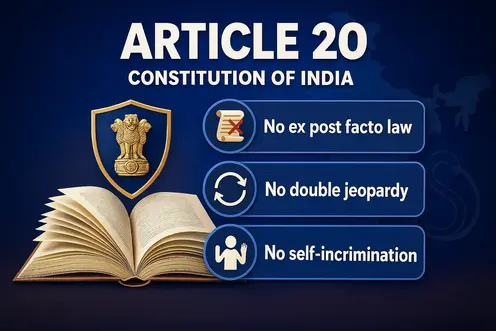
Article 20 of the Indian Constitution

Article 20 of the Indian Constitution: Shielding Justice through Due Process

Introduction: ARTICLE 20 of the Indian Constitution “It is better that ten guilty persons escape than that one innocent suffer.” — William Blackstone No legal principle better captures the spirit of justice in this way. The idea that fairness must be uppermost to retribution captures the spirit of Article 20 of the Constitution of India.

Article 20 of the Indian Constitution: Shielding Justice through Due Process Read More »

Freedom of Speech & Expression

Freedom of Speech & Expression – Power, Limits, and the Changing Digital Reality

Introduction Citizens exercise free expression to render their government accountable, to inform citizens, and to participate as actors in the process of nation-building. Article 19(1)(a) of the Indian Constitution provides free expression to every citizen so that every citizen can express opinions in whatever format – written, verbal, visual, audio, online or digital interactive (regrettably,

Freedom of Speech & Expression – Power, Limits, and the Changing Digital Reality Read More »

Scroll to Top