Introduction
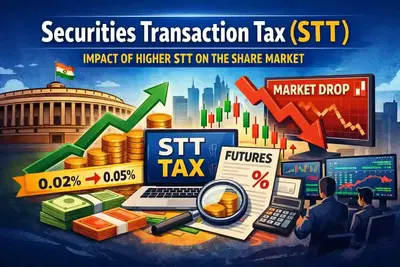
Taxes heavily impact financial markets because they control market activities and influence how investors act. The recent drop in the share market following the government’s announcement of the Union Budget has increased concerns from investors regarding their transaction costs as a result of an increase in the Securities Transaction Tax (STT) on Future transactions from 0.02% to 0.05%. The Government has instituted a new direction for regulating derivative trading in India and generating revenue.
Importantly, the Fiscal Responsibility and Budget Management (FRBM) Act plays a key role in guiding the government’s fiscal policies, ensuring that decisions like changes in STT align with objectives of fiscal discipline and sustainable public finance.
The implications of this subject hold significant importance for candidates in the UPSC Prelims and Mains; specifically when considering the Economy, as well as the Budget.
Overview of the Securities Transaction Tax (STT)
The Securities Transaction Tax (STT) is a direct tax levied on the buying and selling of securities in India. The Central Government collects this tax, similar to how it collects other direct taxes.
Moreover, in India, STT only applies to transactions carried out over a recognised Stock Exchange.Such a structure leads to efficient and effective collection processes from an administrative perspective, as well as providing as much transparency as possible to assist in providing good oversight of such transaction activities.
History of Securities Transaction Tax (STT)
The STT was introduced in 2004. It was introduced with the following objective:
- To ensure effective, efficient and timely collection
- To facilitate a reduction in tax evasion as it relates to the trading of securities
- To provide better oversight by regulators regarding high value financial transactions which occur on a regular basis in the financial markets in India.
Securities that fall under the STT category include:
Securities Transaction Tax (STT) is applied to various instruments that are traded via recognized stock exchanges as follows:
- Equity Shares
- Equity Mutual Funds
- Derivatives such as Futures & Options
- Exchange Traded Funds (ETF’s)
Latest Budget Announcement Regarding STT
The latest Union Budget includes an increase in STT on Futures.
- Previous Rate: 0.02%
- New Rate: 0.05%
The Government appears to indicate an intent to do the following:
- Increase tax revenue from a rapidly growing derivative market.
- Curb excessive speculative trading activity, especially with respect to Futures.
Why did the Government Increase STT on Futures?
The increase in STT on Futures is largely driven by:
- Firstly, there has been rapid growth in derivative trading volume in recent years.
- Additionally, growing retail investor participation in high-risk derivative instruments has been observed.
- Therefore, there is a need to discourage short-term speculative trading behaviour.
- Finally, taxation policy should be aligned with financial market stability objectives.
Impact of Higher STT on the Stock Market
The increase in STT on Futures has had a mixed effect on the stock market.
Positive Effects:
- May help to reduce excessive and speculative trading in derivatives.
- Will possibly encourage long-term investments rather than short-term speculation.
- Will ultimately contribute to an overall increase in market stability.
Negative Effects:
- Will increase transaction costs for traders.
- Will probably reduce the amount of trading, particularly in the Futures segment.
Comparison: Securities Transaction Tax (India) vs Stock Trade Tax (USA)
| Aspect | Securities Transaction Tax (India) | Stock Trade Tax (USA) |
|---|---|---|
| Existence of Tax | Yes. India levies STT on securities transactions through recognised stock exchanges. | No broad-based stock transaction tax exists in the USA. |
| Nature of Tax | Transaction-based direct tax; payable regardless of profit or loss. | No transaction tax; taxation is mainly profit-based. |
| Securities Covered | Equity shares, equity mutual funds, ETFs, derivatives (futures & options). | No specific transaction coverage; trading itself is not taxed. |
| Rate Structure | Fixed rates notified by Government; STT on futures increased from 0.02% to 0.05%. | No STT-like rate; only a nominal SEC fee on sell transactions. |
| Objective | Easy tax collection, reduce tax evasion, monitor market activity. | Maintain high liquidity and low transaction costs. |
| Impact on Traders | Increases cost for frequent and derivative traders. | Encourages high-frequency and large-volume trading. |
| Impact on Long-term Investors | Minimal impact on long-term equity investors. | Investor-friendly due to absence of transaction tax. |
| Capital Gains Tax | Paid in addition to STT (STCG/LTCG applicable). | Primary tax on stock market income (short-term & long-term gains). |
| Policy Approach | Focus on revenue certainty and regulation. | Focus on market efficiency and depth. |
Securities Transaction Tax (STT) vs. Capital Gains Tax: A Quick Comparison
Securities Transaction Tax (STT) is charged on purchasing or selling securities.
Capital Gains Tax is an income tax applied to gains received from the sale of securities.
STT applies if an investor has a loss, but Capital Gains Tax is due only if the investor has a gain.
UPSC Examination Relevance
For Prelims Section:
- To begin with, Define and Explain Securities Transaction Tax (STT)
- Next, Changes to STT on Future and its relevance in the recent Budget
- Then, List of Financial Instruments that STT is Levied Against
For Main Section, GS-III:
- Firstly, Role of Government to Regulate Financial Markets
- Subsequently, Effects of Taxation Policies on Investor and Market Dynamics
- Need to Balance Revenue Creation and Market Efficiency & Stability
Conclusion
The increase of STT on futures is indicative of a moving policy direction towards being more cautious in our regulation of the derivatives market.
While STT on futures increases the cost of trading, implementing this advantage aims to promote financial stability and responsible participation to the market.
STT on futures demonstrated how Budgetary Decisions can impact “Economic Behaviour and Trends.”
UPSC CSE Prelims PYQs: Securities & Stock Markets
Q1. UPSC CSE Prelims 2016
What is the primary function of derivatives in financial markets?
(a) Mobilising long-term capital
(b) Price discovery and risk management
(c) Providing credit to industries
(d) Regulating stock exchanges
Correct Answer: (b)
Q2. UPSC CSE Prelims 2018
Which of the following are traded in the stock market?
- Equity shares
- Derivatives
- Exchange-Traded Funds (ETFs)
- Treasury Bills
Select the correct answer using the code given below:
(a) 1 and 2 only
(b) 1, 2 and 3 only
(c) 2 and 4 only
(d) 1, 2, 3 and 4
Correct Answer: (b)
Frequently Asked Questions (FAQs)
STT is not always charged on both sides.
– In equity delivery trades, STT is charged on both buying and selling.
– In intraday trading and derivatives, STT is generally charged only on the selling side.
Yes. STT is payable even if the transaction results in a loss, as it is charged on the value of the transaction, not on profit.
STT is collected by the broker at the time of transaction and then deposited with the Central Government.
No. STT is applicable only on transactions carried out through recognised stock exchanges.
Off-market or private share transfers do not attract STT.
The government prefers STT because it ensures:
– Easy and assured tax collection
– Lower chances of tax evasion
– Better monitoring of high-value market transactions