Introduction
RCEP (Regional Comprehensive Economic Partnership) was recently mentioned in the news when Indian Prime Minister Narendra Modi signed an FTA (Free Trade Agreement) with New Zealand, indicating India’s renewed interest in increasing Economic Ties to the Indo-Pacific Region. In addition to this, India is also looking at the possibility of signing FTAs with many of the countries that are members of RCEP, as an opportunity to expand India’s Trade Reach.
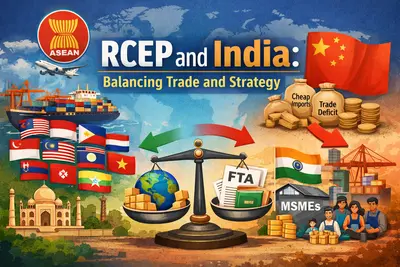
The exception of the Country of China is clear in India’s view of RCEP. The hesitation that India has for proceeding with discussions to move forward with an FTA regarding China could be attributed to:
- Influx of Cheap Chinese-Goods into India;
- Trade Balance Deficit with China, afflicted by unfair negotiating practices by China;
- Risk of Indian MSME’s suffering or going out of business due to pricing pressure from Chinese-Goods.
The Rise in the RCEP area of focus may have also occurred as a result of India’s Development of a New Trade Strategy to develop a balance between both Economic Growth and Geopolitical and Domestic Strategic considerations when engaging in trade.
Information Related to the UPSC Examination for all the subjects of GS II and GS III Trade Policy, Geopolitics, National Security/Economic Security.
What Is RCEP?
RCEP is
- A Mega Free Trade Agreement (FTA), involving Countries of the East Asia and Indo-Pacific region;
- A Framework derived from current ASEAN +1 FTAs;
- Multi Economy Integration, to create One Economic Trade Area.
The basic goals of the RCEP:
- To establish an up-to-date, complete, a high calibre, and mutually advantageous free-trade area.
- To enhance regional economic integration by lowering barriers to trade and enhancing cooperative activities between all RCEP members as a whole.
Prelims Tip: The RCEP represents one of the world’s largest free trade areas based on population and GDP.
ASEAN: The Centre piece of RCEP
What is ASEAN?
On August 8, 1967 (grade E), the Association of Southeast Asian Nations (ASEAN) was created to foster increased cooperation and stability in Southeast Asia.
ASEAN’s 10 Member States:
- Brunei
- Cambodia
- Indonesia
- Laos
- Malaysia
- Myanmar
- Philippines
- Singapore
- Thailand
- Vietnam
ASEAN+1 FTAs: Foundation of RCEP
ASEAN already had FTAs with six partners:
| ASEAN Partner | Agreement |
|---|---|
| China | ACFTA |
| South Korea | AKFTA |
| Japan | AJCEP |
| India | AIFTA |
| Australia & New Zealand | AANZFTA |
RCEP was built by merging and upgrading these FTAs
ASEAN as the Central Point for RCEP
ASEAN provides the institutional framework that allows RCEP countries to work together and prevents the regional integration process from being solely the product of one major global player.
By acting as the Central Point in the RCEP model, ASEAN looks to:
- Preserve a balance among the world’s largest economies
- Foster inclusive regional growth across the full spectrum of RCEP membership
- Mitigate the gaps in economic development among the ten ASEAN member countries.
Mains Value: RCEP’s central role for Southeast Asia and multilateralism represents a critical piece of stabilising the Indo-Pacific Region.
The Formation Timeline and Negotiations for RCEP
The Regional Comprehensive Economic Partnership (RCEP) was first proposed in November 2012 when the 16 Economic Ministers agreed to develop a Single Regional Framework.
November 2012 – RCEP was officially launched during the 21st ASEAN Summit in Phnom Penh, Cambodia.
Member Countries:
10 ASEAN Member States
6 ASEAN Free Trade Agreement partners:
- India
- China
- Japan
- South Korea
- Australia
- Newzealand
Objectives of RCEP
To establish a modern, high-quality, inclusive trade agreement for all economies involved in RCEP.
Key Objectives of RCEP:
- To strengthen trade between countries in goods and services.
- To facilitate the free flow of foreign direct investments between the countries in RCEP.
- To enhance both regional and global supply chains.
- To reduce all tariff and non-tariff trade barriers.
- To close the development gap between RCEP member states.
Areas of Coverage Under the RCEP
RCEP negotiations were not confined to specific areas of economics or trade; rather they were comprehensive, covering a wide range of economic and trade-related topics, thus making them a highly significant topic for UPSC Prelims.
Major Areas of Coverage Under the RCEP:
- Trade in goods.
- Trade in services.
- Foreign direct investment.
- IPR (Intellectual Property Rights).
- Competition Policy.
- E-Commerce.
- Dispute Settlement Mechanism.
- Support for Small and Medium Enterprises (SMEs).
- Technical and Economic Development Cooperation.
All direct questions that could appear in the UPSC Prelims Examinations will be in the format of matching or identifying incorrect statements.
How Important is RCEP Globally?
RCEP is the largest trade bloc in the world in terms of both economic and demographic size.
Importance of RCEP Globally:
- Almost 50% of the population of the world is in RCEP countries.
- Approximately 30% of the global Gross Domestic Product comes from RCEP member countries.
- About 25% of the world’s exports are shipped from RCEP member countries.
The following are the main benefits of RCEP:
- Reduction in tariff rates and reduced non-tariff trade barriers.
- Increased access to markets for goods and services.
- Integrative regional supply chains.
- Improved access of Small and Medium Enterprises (SMEs) and micro enterprises.
What does RCEP really mean for businesses and SMEs?
RCEP also places a very high priority on the importance of SMEs (small and medium enterprises) as they represent more than 90% of all registered businesses in the RCEP member countries.
By providing for entry into a larger number of global and regional supply chains, the RCEP will lead to the development of new regional and global markets for SMEs, and provide an easier and faster route to market. Additionally, because of the reduction of tariffs and non-tariff barriers, SMEs will be able to sell more competitively in both Rio and global markets.
Economic Benefits for All RCEP Member Countries:
- The RCEP encourages higher levels of transparency in the rules and practices of trade;
- Encourages practices that promote fair trade; and strengthens the economic ties among member nations.
- The integration of SMEs under the RCEP will provide the basis for inclusive economic growth and will allow every member nation to experience the social and economic benefits that will derive from sustainable economic growth.
Why did India choose to withdraw from RCEP?
India withdrew from the RCEP negotiation process (in 2019) for many economic and strategic reasons.
PRIMARY REASONS FOR INDIA’S WITHDRAWAL:
CHINA
- India feared there was a possibility China would flood the Indian market with goods.
- India had a very large and persistent trade deficit with China.
- There was a risk India could become a dumping ground for Chinese goods.
THREAT TO Indian MSMEs
- The development of cheaper imported products could reduce the competitiveness of domestic products manufactured in the Indian MSME sector.
- Many small-scale manufacturers may no longer be able to compete.
AGRICULTURE
- The entry and increased volume of dairy imports could put at risk many farmers’ livelihoods in India.
- Many sensitive agriculture products could see increased global competition.
LACK OF ADEQUATE SAFEGUARDS
- There are very little mechanisms to protect against sudden import surges into India from other RCEP countries.
- There are not enough safeguards to protect the Indian domestic industry.
India’s New Trade Strategy: FTAs with Some, Not All
India has chosen to implement a deliberate, selective approach to trade integration instead of complete disengagement from foreign markets.
Major Aspects of the New Trade Strategy
- Bilateral Free Trade Agreements (FTAs) with trusted Trade Partners (for example; Bilateral Agreements with New Zealand)
- Engagement with the Regional Comprehensive Economic Partnership (RCEP) countries, excluding China.
Leveraging Sectoral and Balanced Bilateral FTAs
Objectives
1) Market access without creating strategic vulnerabilities.
2) Reducing over-dependence on a limited number of trading partners by Diversifying Trading Partners.
3) Building Resilient and Trusted Supply Chains.
Why RCEP Countries Are Important to India?
- Growth of Indo-Pacific Markets
- The Export of Goods
- Bilateral Trade in the Services Sector
- Increased Digital Trade
Strategically Aligns with:
- Act East Policy
- Indo-Pacific Strategy
- Supply Chain Resilience Initiative
Going Forward: India’s Balanced Trade Agenda
Going forward India should implement a Balanced Trade Agenda to promote growth whilst taking Domestic Issues into consideration.
India’s Primary Trade Focus Areas
- Protect Domestic Industry (Including MSMEs and Sensitive Industries)
- Incentivise Foreign Investment (Stable & Predictable Trade Rules)
- Engage in Selective Integration with Global Trade (No Blanket Liberalisation)
Areas of Focus:
- Incorporation of strong safeguard clauses to counter import surges
- Promotion of sector-specific FTAs based on India’s comparative advantages
- Emphasis on technology, services, and digital exports, where India is globally competitive
Conclusion
India has kept a close eye on RCEP. On one hand, it sees the opportunity that could come from a regionally integrated economy. However, at the same time, India also believes that this opportunity comes with certain risks that require careful consideration, as well as strong strategic economic autonomy.
India has opted not to join RCEP, in large part due to Limited rationales associated with a RCEP membership; on the contrary, however, it has signed FTAs with several RCEP member countries and continues to move forward in developing its own capacity as a regional FTA negotiator, while also selectively responding to the continued liberalisation of trade and globalisation throughout Asia.
FAQ’s
RCEP, or Regional Comprehensive Economic Partnership, is a multilateral initiative led by ASEAN (Association of Southeast Asian Nations) to stimulate trade, investment, and economic integration in the regions of Asia and the Pacific.
India withdrew from RCEP in 2019 due to concerns about a possible increase in Chinese product imports flooding into its market, the size of the trade deficit; the expected protectionist impact on agriculture, MSME producers, and industry; and, finally, the limited safeguards associated with RCEP’s Free Trade Agreements.
RCEP countries adopt the principle of “ASEAN Centrality,” which means ASEAN will be the key focal point for RCEP, thus ensuring balanced participation by all RCEP members and no domination by any major power.
India has established FTA negotiations with RCEP member countries (with the exception of China) and is focusing on using these negotiations to open its markets to those countries, while ensuring that India’s interests (both economic and strategic) continue to be protected.
RCEP countries are key trade partners for India, offering access to Indo-Pacific markets, services exports, and resilient supply chains.