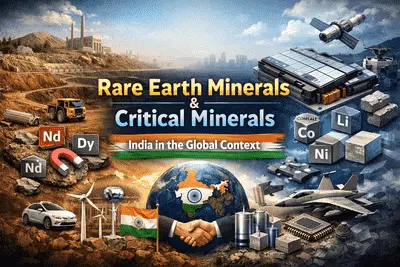
Minerals are important elements in the economy of the 21st century because they provide power to many of the technologies we have today such as; smartphones, electric vehicles, renewable energy systems and the technologies we use for defence.
One of the terms that is receiving increased attention in this transition is; Rare Earth Minerals and Critical Minerals.
- Rare Earth Minerals are actually a category of elements that share common characteristics as a result of their unique electron configurations, which give them special properties.
- Critical Minerals are defined by the economic importance of the mineral and a high risk of disruption to the supply chain of the mineral.
Although there is frequently overlap in the two lists of minerals, not all Rare Earth Minerals are considered Critical Minerals. The purpose of this blog is to define each of the categories of elements and minerals identified above, to provide an overview of India’s mineral resources and to examine the strategic importance of the two categories of minerals on the world stage.
What Are Rare Earth Elements?
Rare Earth Elements are a collection of 17 elements (the 15 lanthanides, and the elements Scandium and Yttrium) which are important for creating advanced electronics and renewable energy technology, lithium batteries, high-performance magnets, defence, and other high-tech applications.
The 17 Rare Earths are cerium (Ce), dysprosium (Dy), erbium (Er), europium (Eu), gadolinium (Gd), holmium (Ho), lanthanum (La), lutetium (Lu), neodymium (Nd), praseodymium (Pr), promethium (Pm), samarium (Sm), scandium (Sc), terbium (Tb), thulium (Tm), ytterbium (Yb), and yttrium (Y).
Rare Earth Elements (REE) are not particularly rare in the Earth’s crust; the reason for the “rare” name comes from:
- Rare Earth elements being found in extensive disseminated locations instead of in concentrated deposits.
- Rare Earth extraction, separation, and refining operations are technologically challenging, economically prohibitive and environmentally sensitive.
As a result, only a few countries dominate the production of Rare Earth separating and refining operations around the world, which can create a significant risk in the supply chain globally.
Key Rare Earth Minerals and Major Source Regions in India
| Mineral | Significance | Major Source Regions (States) |
|---|---|---|
| Monazite | Primary source of rare earth oxides (REOs); most abundant | Kerala, Odisha, Tamil Nadu, Andhra Pradesh |
| Xenotime | Rich in heavy rare earth elements | Jharkhand, West Bengal, Maharashtra |
| Bastnäsite | Important commercial rare-earth mineral | Gujarat, Rajasthan |
Among these, monazite is the most economically important. India possesses about 13.15 million tonnes of monazite, which contains an estimated 7.23 million tonnes of rare earth oxides (REOs) — providing a strong raw-material base for downstream industries.
Uses and Applications of Rare Earth Elements
Rare Earth elements have many applications in high-tech industries — the following items typically use rare earth elements:
- Electronics: including cell phones, electronic displays, semiconductors (microchips), and hard drives.
- Clean Energy: including motors used in electric vehicles; generators in wind turbine systems using permanent magnets.
- Defence and Aerospace technology: including missile guidance systems; radar systems; lasers; high-precision sensors.
- Medical Technology: including Magnetic Resonance Imaging (MRI) machines; advanced diagnostic and imaging technology.
Rare Earth elements are very difficult to substitute because they have unique magnetic and electronic properties.
The Geological Survey of India (GSI) has significantly expanded India’s resource assessment. Through 34 exploration projects, GSI has identified 482.6 million tonnes of rare-earth ore resources, strengthening the country’s long-term supply potential.
Processing and refining are primarily undertaken by IREL (India) Limited, with facilities in Odisha and Kerala.
International Reserve Ranking
Globally, rare earth reserves are concentrated in a few countries.
| Country | Global Position | Major Rare Earth Metals Present | Share of Global REE Reserves (Approx.) |
|---|---|---|---|
| China | Largest reserves and dominant processor | Neodymium, Praseodymium, Dysprosium, Terbium, Lanthanum, Cerium | 35–40% |
| Brazil | Large geological reserves | Lanthanum, Cerium, Neodymium | 20% |
| Vietnam | Significant emerging reserves | Neodymium, Praseodymium, Yttrium | 18% |
| Russia | Substantial deposits | Lanthanum, Cerium, Neodymium | 10% |
| India | Among top global holders | Monazite-based REEs (Cerium, Lanthanum, Neodymium, Thorium-associated REEs) | 6–7% |
India has a large amount of geological Rare Earth resources, however, historically, due to a lack of downstream processing and permanent magnet manufacturing capabilities, India relies heavily on imports for its Rare Earth needs.
Rare Earth Permanent Magnet (REPM) Manufacturing Scheme
To help reduce its reliance on imported rare earths and strengthen domestic manufacturing, the Government announced a comprehensive REPM scheme.
The REPM scheme will support the manufacturing industries and sectors that utilize rare earths in products including electric vehicles (including electric mobility), renewable energy (including solar and wind), electronics, aerospace, and defense.
Union Budget 2026-27: Creation of Dedicated Rare Earth Corridors
The Union Budget 2026-27 announced the establishment of Dedicated Rare Earth Corridors, which are the next step in expanding the scope of the REPM scheme.
States That will have Dedicated Rare Earth Corridors
Odisha, Kerala, Andhra Pradesh, and Tamil Nadu.
Dedicated Rare Earth Corridors will facilitate extraction, processing, research, and manufacturing for each state in close proximity to existing infrastructure and also will take advantage of each state’s mineral wealth. These corridors will fit within the overall operational footprint of IREL (India) Limited, which is the leading producer of rare earths in both Odisha and Kerala, and has extraction and refinement operations in those states.
Strategic & Institutional Support for Rare Earths in India
IREL (India) Limited, under the Department of Atomic Energy, is the lead agency performing extraction and refinement of rare earths in India.
MMDR Act as Amended in 2023: This law has opened the door to private sector participation in the rare earth supply chain and recognizes certain critical and strategic minerals, including rare earths.
Alignment with National Initiatives:
- Atmanirbhar Bharat
- Net Zero 2070
- Viksit Bharat at [year 2047].
- National Security / Supply Chain Resilience
These initiatives represent a significant and comprehensive shift to establish the capacity to manufacture rare earths as a strategic priority for India and build an integrated domestic supply chain for rare earths.
Critical Minerals
Definition of Critical Minerals
“Critical minerals” refers to various types of minerals that are vital to many key economic and strategic sectors but, at the same time, are subject to a high probability of being interrupted in supply. A mineral can be considered critical when it meets certain criteria, which may not just be its abundance, but a combination of the following:
- There are a limited number of sources for the mineral.
- Geopolitical risks associated with the sources of supply.
- Increased demand from new and/or emerging technologies.
To classify a mineral as “critical” requires taking into consideration several factors:
- Dependency on Imports
- Strategic Importance (i.e. energy, defense, technology)
- Concentrated Sources of Supply (and producers) Globally
Critical minerals are not the same as rare earth minerals because critical minerals comprise a dynamic list of minerals that are periodically classified and/or reclassified by various governments based upon their own strategic priorities.
List of Critical Minerals in India
The Government of India has officially published a list of critical minerals as defined under the Mines and Minerals (Development and Regulation) Act (MMDR Act). This list will be revised and updated from time to time based upon emerging developments.
India’s identified critical minerals and their strategic significance include:
| Critical Mineral | Strategic Importance |
|---|---|
| Lithium | Core component of EV and energy storage batteries |
| Cobalt | Enhances battery stability and energy density |
| Nickel | Used in advanced battery chemistries and alloys |
| Graphite | Essential for battery anodes and electronics |
| Vanadium | Used in high-strength alloys and energy storage |
| Titanium | Aerospace, defence, and lightweight engineering |
The Uses and Applications of Critical Minerals
Critical minerals are essential components of many modern and emerging technologies:
- Electric Vehicles: Critical minerals like lithium, cobalt, and nickel have applications in the production of batteries for electric vehicles.
- Renewable Energy: Critical minerals such as lithium and cobalt are also important for energy storage systems, in particular grid scale batteries.
- Defence and Aerospace : Critical minerals are an important ingredient in high performance alloys, aircraft structures, and missiles.
- Electronics and Semiconductors: Critical minerals are the building blocks of chips, printed circuit boards, and modern electronic components.
Critical minerals’ growing importance in the context of India’s clean energy transition and strategic independence is evident through their use in the manufacturing of electric vehicles; energy storage systems; and defence systems.
Sources of Critical Minerals in India
India has limited domestic supply of critical minerals.
Lithium deposits have been located in:
- Jammu & Kashmir
- Rajasthan(Exploration stage)
The amount of critical minerals produced in India is low, leading to high levels of imports. In light of these factors, India is takes steps to strengthen its focus on critical minerals by:
- Recycling of critical minerals
- Acquiring critical minerals from overseas sources
- Forming strategic partnerships with resource rich countries
Global Reserve Leaders in Critical Minerals
Global reserves of critical minerals are highly concentrated, creating supply vulnerabilities.
Major Global Reserve Holders
| Mineral | Leading Countries |
|---|---|
| Lithium | Chile, Argentina, Australia |
| Cobalt | Democratic Republic of Congo |
| Graphite | China |
| Nickel | Indonesia, Australia |
| Vanadium | China, Russia |
India remains an emerging player, largely dependent on imports for most critical minerals.
National Critical Minerals Mission (NCMM), 2025
To address supply risks, India launched the National Critical Minerals Mission (NCMM) in 2025 as a comprehensive strategy to secure domestic and global supply chains.
Key Features of NCMM
| Focus Area | Details |
|---|---|
| Innovation | Target of 1,000 patents by 2030 |
| Institutional Support | Creation of 7 Centres of Excellence |
| Recycling | ₹1,500 crore incentive scheme for recycling capacity |
| Core Objectives | Exploration, technology development, sustainability |
The mission marks a shift from import dependence toward long-term supply security and technological self-reliance.
International Partnerships and the Role of KABIL
Due to the lack of domestic sources, India has been creating and strengthening numerous international mineral partnerships.
Bilateral Agreements with:
- Australia, Argentina, Zambia, Mozambique, Peru, Zimbabwe, Malawi, Cote d’Ivoire
- Multilateral Partnerships:
- Minerals Security Partnership
- Indo-Pacific Economic Framework
Role of KABIL
| Aspect | Details |
|---|---|
| Structure | JV of NALCO, HCL, and MECL |
| Mandate | Acquire and develop overseas mineral assets |
| Key Initiative | Lithium brine exploration in Argentina (CAMYEN agreement) |
KABIL plays a crucial role in integrating overseas resources into India’s domestic value chains.
Rare Earth Minerals vs Critical Minerals: A Comparison
| Aspect | Rare Earth Minerals | Critical Minerals |
|---|---|---|
| Nature | Specific group of 17 elements | Broad category based on strategic need |
| Examples | Neodymium, Dysprosium | Lithium, Cobalt, Graphite |
| India’s Strength | Strong geological resource base | Limited domestic availability |
| Key Challenge | Processing and magnet manufacturing | Import dependence |
| Policy Focus | REPM schemes and Rare Earth Corridors | NCMM, recycling, overseas asset acquisition |
Challenges in India
India’s ability to secure its mineral supply chains is hindered by various structural barriers:
- A lack of sufficient infrastructure for refining and processing minerals, particularly in downstream manufacturing
- A lack of new technologies for exploration and separation processes, along with technologies needed to integrate into value chains.
- Environmental and regulatory challenges associated with extracting minerals
Opportunities for India
However, India has some significant opportunities to increase its competitive position:
- Strategic international partnerships will allow for diversification of supply sources.
- Policy reforms over the past few years have led to increased participation from the private sector.
- The increased domestic demand for EV’s and wind power due to expansions in the clean energy sector.
- Reasonable opportunities both in terms of “Make in India” and through value-added manufacturing and integration into global markets.
Conclusion
Critical minerals are essential to both economic development and national security in today’s modern world; where rare earth minerals provide critical performance materials for new high performance technologies and clean energy systems, the critical minerals provide resilience to the supplies of minerals for new industries.
India’s future lies in combining balanced policies and fora, domestic exploration, domestic manufacturing and global partnerships. By continuing with a combination of sustained policy reform and engaged in strategic investment India can both reduce their reliance on imports, and at the same time, strengthen its clean energy and defence supply chain, while at the same time, emerging as a competitive player in the value chain of the global advanced materials.