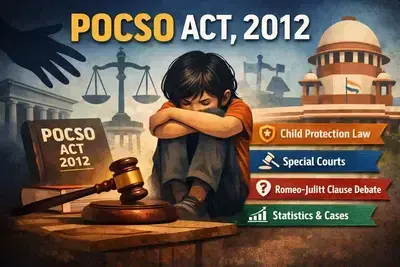
Introduction-POCSO Act
India has seen an increase in the number of reported cases of sexual crimes committed against children in the decade leading up to 2012. The law in place to protect children from sexual offenders at the time (the IPC of 1860) did not adequately describe what constituted a sexual crime against children and lacked any guidelines on how to conduct child-friendly investigations and trials of such crimes.
As a result, many sexual crimes against minors went unreported, and the justice system subjected victims to secondary victimization. Existing laws missed many child sexual offences and lacked child-specific procedures, causing low conviction rates.
To address this, India enacted the POCSO Act 2012, providing a clear, comprehensive framework against child abuse.
From the perspective of the UPSC exam, the most important aspects of the POCSO Act include:
- It was created to support the Constitution’s provision for the protection of children.
- The POCSO Act provides the legal framework for India’s compliance with the UN Convention on the Rights of the Child (UNCRC);
- The Act reformed Indian law by creating special courts and child-friendly investigative and trial procedures.
- Recent Supreme Court rulings on misuse in adolescent relationships have prompted discussions on a “Romeo–Juliet” clause.
The Origin and History of the POCSO Act
In November 2012, Parliament enacted the POCSO Act to provide a comprehensive legal framework protecting children from sexual abuse, harassment, and pornography.
- The Act clearly defines all forms of sexual offences against children and provides protection from exploitation and abuse.
- It establishes child-friendly procedures for reporting offences, conducting investigations, recording evidence, and holding trials through Special Courts for speedy justice.
- The Act is gender-neutral, recognising that children of any gender can be victims of sexual abuse.
Definition of A Child
As stated in Section 2(d) of POCSO, a child is anyone who is under the age of 18 years old regardless of sex or consent. While this section provides protection for children regardless of sex, it has also created debate regarding consensual relationships between adolescents. The Supreme Court and policymakers continue to explore this debate.
Chapters & Key Sections of the POCSO Act, 2012
The POCSO Act has 9 Chapters and 46 Sections, providing a structured legal framework to protect children from sexual offences.
Chapter I – Preliminary
The Act defines a ‘child’ (under 18) and key terms like sexual offences, assault, aggravated offences, and pornography.
Chapter II – Sexual Offences Against Children
The Act covers all sexual offences against children, starting with penetrative sexual assault, which is broader than rape.
It includes sexual assault and aggravated sexual assault, involving acts with sexual intent.
It also covers sexual harassment, such as displaying pornography or making sexually explicit remarks.
Finally, it addresses child pornography offences.
Chapter III – Child Sexual Exploitation
It punishes anyone involved in child pornography, including creating, distributing, storing, or facilitating sexual exploitation through such material.
Chapter IV – Reporting Procedures for Reporting Offences
It mandates parents, teachers, doctors, and others to report child sexual offences, closing gaps in reporting abuse.
Chapter V – Procedure & Power of Special Courts
Specifies the procedure for the conduct of all Special Courts. It ensures in-camera trials, child-friendly procedures, and evidence recording to prevent further victimisation of child abuse survivors.
Chapter VI – Judgments & Orders
The sixth chapter of the POCSO Act outlines how punishment should be given to offenders of different types of crimes.
Chapter VII: Special Courts
It discusses how every district in India should have a special court set up specifically for the purpose of quickly trying cases under POCSO.
Chapter VIII: Evidence and Procedure
This Chapter describes how evidence will be recorded using child sensitive methods. For example, the child should never be confronted directly with the accused.
Chapter IX: Miscellaneous
Chapter IX includes information about how children will receive assistance and rehabilitate, how the government will create monitoring mechanisms, the powers of government to create rules and regulations, and the overall responsibility of the government for implementing POCSO.
Courts and Institutions under POCSO
Special Courts
Each district must have a Special Court under POCSO for speedy, child-friendly trials with in-camera, trauma-sensitive procedures.
Fast Track Special Courts (FTSC)
The government set up Fast Track Special Courts to speed up investigation and trial of child sexual offence cases under POCSO.
At present, there are approximately seven hundred and forty-five FTSCs throughout India, of which over four hundred are designated for the exclusive trial of POCSO cases, but there is still a significant backlog of cases awaiting trial, and many cases are taking longer than the time prescribed by the law to get to trial, largely because of a lack of available Judges, Prosecutors and Court Facilities in India.
Monitor Bodies
The Board of National Commission for the Protection of Child Rights (NCPCR) and equivalent State Support Boards ensure that guidelines are implemented as per Act and will uphold those that protect
Yearly Statistics & Trends under POCSO case
Case load of POCSO
Government data shows rising registered POCSO cases, reflecting increased reporting of child sexual and physical offences in India.
Trial & Pendency Issues
But, Possibly & in fact most, 85–90% of POCSO cases will remain pending in trial in some years because of institutional constraints and a lack of suitably qualified legal personnel and court capacity as well as intense delays in litigation. These concerns have raised issues regarding the speed and effectiveness of the fast-tracking mechanism provided under POCSO.
Latest Supreme Court Statements: Romeo–Juliet clause, Bail Guidelines
In January 2026 the Supreme Court called for the Union Government to come up with a ‘Romeo-Juliet clause’ in the POCSO Act, so as to limit the risk of misuse of the law against consensual adolescent relationships. It noted that there are instances of families using the Act to resolve family disputes thus creating and charging young couples with unjust crimes.
Additionally, the court added that the mandatory requirement of determining the age of the child by way of medical ossification tests prior to the determination of bail is not allowed as this contravenes the principles of due process.
The discrepancy between protecting children from abuse and unreasonably penalizing adolescent consensual dating is demonstrated in this case through the intervention of the courts.
Advantages of the POCSO Act
- Full Coverage for Child Victims of Sexual Offences
This legislation is gender-neutral and provides a comprehensive definition for sexual offences, covering various types of sexual abuse. - Child Sensitive Procedures
Trial procedures like conducting trials in-camera and using sensitive methods for capturing evidence reduce traumatization and secondary victimization of child victims. - Special Courts and Fast Track Systems
The creation of Special Courts and fast-track systems allow for more focused processing and faster resolution of child sexual abuse cases. - Deterrence and Awareness
Mandatory reporting of child sexual offences and harsh penalties act as deterrents and promote greater awareness of child sexual abuse in society.
Disadvantages and Complaints
- Misuse of the Law
Several cases reveal the use of POCSO in family disputes or to criminalise consensual adolescent relationships, a concern recently highlighted by the Supreme Court.
- Trial Delays Despite FTSCs
Although fast-track courts exist, the average disposal time often exceeds prescribed timelines, diluting the objective of speedy justice.
- Resource and Infrastructure Gaps
Many districts face a shortage of dedicated courts, trained judges, prosecutors, and child counsellors, affecting effective implementation.
- Ambiguity in Consensual Cases
The absence of a statutory exemption for consensual teenage relationships has led to legal uncertainty and growing demands for reform.
Representatives’ Cases and Examples
Recent Convictions:
Jan 2026 Pune, India: A 5-year term imprisonment was handed down to a man found guilty of aggravated sexual assault under the POCSO Act by a Special Court.
Jan 2026 Gujarat, India: Two brothers received 20 years of rigorous imprisonment after their conviction for the rape of a minor.
Judicial Clarifications:
In the view of the Supreme Court, sexual intention is one of the most important aspects of the definition of an offence under the POCSO Act.
Key Takeaways for UPSC Aspirants:
- How Child Rights, Constitutional Safeguards, and Criminal Justice are Related.
- Issues with how to support children in an effective manner while maintaining safeguards against misuse, especially with regard to the Romeo and Juliet issue.
- The role of Procedural Law, Judicial Structures, and Institutional Capability in Implementing Public Policies.
- The use of Data to obtain credible and valid legal resolution examples.
Conclusion
The POCSO Act of 2012 continues to be an integral part of the Indian Child Protection System, including Child-Friendly Processes and full Legal Protection. However, the ongoing Judicial Discourse around Teenagers in Consensual Relationships indicates the critical need for an in-depth approach to reform. An Appropriate balance is needed to provide optimal protection for children yet not over-criminalize the consent of teenagers so as to enhance both Justice and Equity in the Indian Justice System.
Frequently Asked Questions (FAQs) on the POCSO Act
1. What is the POCSO Act?
The POCSO Act, 2012 is a special law enacted to protect children (below 18 years) from sexual offences, sexual harassment, and pornography through child-friendly legal procedures.
2. Is the POCSO Act gender-neutral?
Yes. The POCSO Act is gender-neutral and protects both boys and girls from sexual offences.
3. Is consent of a minor valid under the POCSO Act?
No. Consent of a person below 18 years is not legally valid under POCSO, which is why consensual adolescent relationships can also fall within its scope.
4. Is reporting of POCSO offences mandatory?
Yes. The Act makes reporting mandatory for any person who has knowledge of an offence, and failure to report can attract punishment.
5. What is the punishment under the POCSO Act?
Punishment varies by offence and can range from imprisonment of 3 years to life imprisonment, along with fines, depending on the severity of the crime.