Introduction
“Ocean currents are the great regulators of Earth’s climate, redistributing heat and energy across the planet.”
— W.M. Davis, Geologist and Geomorphologist
The continuous movement of ocean water on a large scale (ocean currents) transports heat, moisture and nutrients throughout the globe.
The ocean’s effects can be seen indirectly in the weather and climate of the Earth, along with its impact on marine ecosystems and human habitation.
As climatologists, the question that arises is:
How can it be that, because they are adjacent to oceans, these coastal regions of the world (receiving warm temperate climate) are often arid/desert-like?
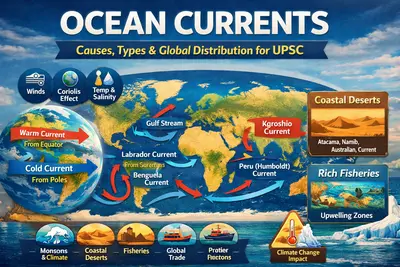
To illustrate, the Atacama Desert on the western coast of South America is one of the most extreme examples. The Atacama Desert receives almost no precipitation at all because of the cold Peru Current. Similar situations exist for the Namib Desert (Benguela Current), West Australian region (West Australian Current), and north and northwest parts of Africa (Canary Current).
Cold ocean currents decrease sea surface temperatures; reduce evaporation from the ocean, and provide stability to the air mass above them (i.e., by holding back hot air masses). This leads to limited rainfall and therefore, aridity. The oceans, therefore, not only provide moisture, but also modify the Earth’s climate.
The ocean currents are the basis for the monsoons that occur over the Indian Ocean, support many of the most productive fishery areas on the planet (through upwelling), and balance the global heat budget. In the context of climate change, their importance has increased further, as disruptions in major systems such as the Atlantic Meridional Overturning Circulation (AMOC) may have far-reaching climatic consequences.
Therefore, a systematic understanding of ocean currents—their causes, types, and global distribution—is indispensable for UPSC aspirants, especially for map-based prelim questions and analytical mains answers.
What are the Ocean Currents?
The ocean currents are constant, directed movements of water that move horizontally and vertically within the oceans.
Ocean Currents: Major Characteristics:
- The currents will move across large distances.
- Ocean currents can be either warm or cold.
- They carry heat, nutrients, and marine organisms.
- They have a major effect on weather and climate.
Ocean Currents: Why Do They Exist?
These currents are caused by an interplay of atmospheric, rotational, and oceanic factors.
Ocean Currents: Major Causes Are As Follows:
- Planetary winds cause surface water to be pushed by the trade winds and the westerlies.
- The unequal heating of the Equator and the poles creates a difference in temperature between the two.
- The Coriolis effect pushes ocean currents to the right in the Northern Hemisphere and to the left in the Southern Hemisphere.
- Warmer water stays near the surface; colder water sinks and creates a gradient.
- The increased density of saline water supports deep oceanic currents.
- The landmasses block and redirect the movement of ocean currents, creating gyres.
Types of Ocean Currents.
1. Temperature Based
- Warm Currents: Those that flow toward higher latitudes from the equatorial regions are referred to as warm currents. Example: Gulf Stream, Kuroshio Current.
- Cold Currents: Those that flow toward the equator from the polar regions are referred to as cold currents. Example: Labrador Current, Peru Current.
2. Depth Based
- Surface Currents: Those that are driven by wind and influence climate.
- Deep Ocean Currents: Those that are driven by thermohaline circulation, or temperature and salinity.
Major Ocean Currents of the World
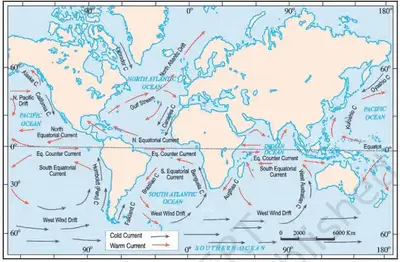
North Atlantic Ocean Currents
| Current Name | Direction (From → To) | Cause of Current | Nature |
|---|---|---|---|
| Gulf Stream | Gulf of Mexico → North Atlantic | Trade winds, Coriolis force | Warm |
| North Atlantic Drift | Central Atlantic → Western Europe | Extension of Gulf Stream | Warm |
| Labrador Current | Arctic Ocean → Newfoundland | Polar cold water movement | Cold |
| Canary Current | Western Europe → North Africa | Westerlies, coastal deflection | Cold |
South Atlantic Ocean Currents
| Current Name | Direction (From → To) | Cause of Current | Nature |
|---|---|---|---|
| Brazil Current | Equatorial Atlantic → Brazil coast | Trade winds | Warm |
| Benguela Current | Southern Atlantic → Western Africa | Westerlies, upwelling | Cold |
| Falkland (Malvinas) Current | Southern Ocean → Argentina coast | Polar cold water flow | Cold |
| South Atlantic Drift | South America → Africa | Westerlies | Cold |
North Pacific Ocean Currents
| Current Name | Direction (From → To) | Cause of Current | Nature |
|---|---|---|---|
| Kuroshio Current | Philippines → Japan coast | Trade winds, Coriolis force | Warm |
| North Pacific Drift | Japan → Western North America | Westerlies | Warm |
| Oyashio Current | Bering Sea → Japan | Polar cold water movement | Cold |
| California Current | North Pacific → Western USA | Westerlies, coastal upwelling | Cold |
South Pacific Ocean Currents
| Current Name | Direction (From → To) | Cause of Current | Nature |
|---|---|---|---|
| East Australian Current | Coral Sea → Tasmania | Trade winds | Warm |
| Peru (Humboldt) Current | Southern Pacific → Peru–Chile coast | Trade winds, upwelling | Cold |
| South Pacific Drift | South America → Australia | Westerlies | Cold |
| West Wind Drift | Around Antarctica → Pacific sector | Polar easterlies | Cold |
Indian Ocean Currents
| Current Name | Direction (From → To) | Cause of Current | Nature |
|---|---|---|---|
| Somali Current | Seasonal reversal (SW-NE) | Monsoon winds | Warm/Cold (Seasonal) |
| Agulhas Current | Indian Ocean → Southern Africa | Trade winds | Warm |
| West Australian Current | Southern Indian Ocean → Western Australia | Westerlies | Cold |
| Equatorial Current | East → West along equator | Trade winds | Warm |
Significance of Ocean Currents
There is a connection between ocean circulation, climate and life-supporting systems on Planet Earth. Ocean currents have a wide range of impacts, which include climate, ecology and the economy of humans.
1. Regulation of Global Climate
Ocean currents displace warm waters from near the equator to areas further away from the equator, which helps regulate the temperature of the entire planet; for example, the Gulf Stream and North Atlantic Drift provide warm water to Western Europe and the rest of the world; however, cold ocean currents provide cooling to coastal areas and therefore have an impact on climate zones in the world.
2. Influence on Rainfall and Desert Formation
Warmed ocean currents provide increased evapo-transpiration, which in turn provides additional moisture to land bordering the ocean. Cold ocean currents inhibit the evaporation of water, reducing moisture in the atmosphere and thus increasing the stability of air masses near cold currents, which leads to the development of desert conditions.
3. Role in Monsoon and Atmospheric Circulation
The warm current flowing through the Eastern Pacific Ocean provides moisture to the continents of North America and South America. This evaporation and the moisture that become distributed by winds over the western portion of the continent, produce the rainfall in these two regions and help to create pressure systems in the Indian Ocean region. However, the change in Pacific Ocean currents that was the cause of these systems was related to an event known as the El Niño, with the opposite phenomenon being called the La Niña.
4. Assistance to Marine Ecosystem and Fisheries:
Cold oceanic currents and upwellings provide nutrient-rich water, which stimulates the growth of phytoplankton; this is the basis of the world’s richest fisheries in the following locations:
- Peru Current
- Benguela Current
These areas contribute to livelihoods and food security on a global basis.
5. Impacts on Human Activities and Trade Routes:
From ancient times, oceanic currents have served to guide navigating ships and define trade routes. By saving fuel and reducing time spent traveling, current systems have also allowed the growth of port cities and coastal communities.
6. Role of Ocean Currents in Climate Change and Global Warming:
Oceans are carbon sinks, which means that they absorb large amounts of CO2 from the atmosphere. Climate change may disrupt ocean currents like the Atlantic Meridional Overturning Circulation (AMOC) — which will ultimately result in serious adverse weather conditions, rising sea-levels, and long-term climatic instability.
7. Significance of Ocean Currents to Disaster Preparedness and Environmental Management:
Marine heat waves, cyclone intensity, and even the dispersal of pollutants and marine debris occur as a result of current systems. Understanding how to monitor and utilize oceanic currents can assist in both disaster and environmental management.
Conclusion
Oceanic currents are critical for maintaining climate, rainfall patterns; sustaining marine ecosystems; and supporting human activities (e.g., fisheries and navigation). As global climate change continues to progress, the need for a further understanding of current flow patterns and their impacts will only grow more necessary. The oceans and ocean currents are a topic of major interest for the UPSC.
Frequently Asked Questions (FAQs)
1. Which ocean shows seasonal reversal of currents?
The Indian Ocean.
2. Why are cold currents associated with rich fisheries?
They cause upwelling of nutrient-rich waters.
3. Which current moderates Western Europe’s climate?
North Atlantic Drift.
UPSC Civil Services Examination – PYQs
Q. Consider the following pairs:
Ocean Current — Associated Coast
- Canary Current — Western Africa
- Peru Current — Western South America
- Kuroshio Current — Eastern Asia
Which of the pairs given above are correctly matched?
Ans: 1, 2 and 3