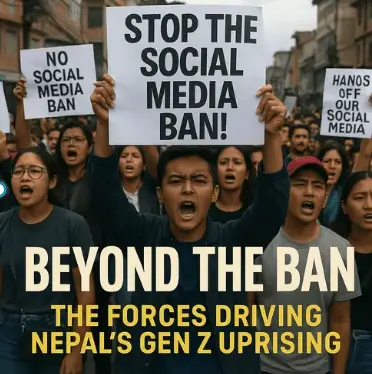
The internet is currently flooded with the news of how Nepal is burning on fire. Viral videos showed ministers running for their lives, angry youth clashing with security forces, government offices set ablaze, and even the Prime Minister resigning and fleeing — all painting a picture of unprecedented devastation. The world is currently trying to understand how youth-led unrest, political turmoil, and violent street protests have suddenly engulfed a peaceful country like Nepal over a social media ban that is both simple and symbolic.
Why social media Ban? Because apps like Tiktok, Whatsapp, Facebook etc were not registered under Nepal’s new Social Media Directive 2024, which required companies to set up local offices, appoint representatives, and follow Nepali content regulations. For the youth, the ban felt like censorship — an attack on free expression, a move to silence criticism, and a trigger that exposed deeper anger over corruption, nepotism, and inequality.
But is all this devastation just because of a social media ban? No. The ban was only the tip of the iceberg — beneath it lies deeper cracks in Nepal’s governance and performance.
Nepal’s Gen Z Uprising: Origins and Causes
Reasons for Nepal’s Uprising
The Gen Z revolt in Nepal may have erupted after the social media crackdown, but a slow, steady fire was brewing. A mix of economic stagnation, social injustice, betrayal in politics, and geopolitical contention created the ideal storm.
Economic Reasons
Nepal’s economy has failed its youth for years. Unemployment levels have remained high, forcing millions of young Nepalis to relocate to the Gulf and Malaysia to survive. At the same time, even such options are shrinking – in the first half of FY25, for example, migrant outflows fell by 26 percent, which includes a stunning 74 percent decline for workers migrating to Malaysia. In Nepal, 82 percent of the workforce works informally, with both workforce participation and informal-to-formal employment ratios far higher than any global or regional averages, leaving most workers without stability or protections.
Remittances, which account for over a quarter of Nepal’s GDP, prop up the economy, but relying on traditional sectors will not generate quality jobs at home and has created a cycle of brain drain and lost opportunities. Remittance inflows made up 12.9 percent of Nepal’s GDP in H1FY24 and 12.4 percent in H1FY25.
The World Bank report provides stark data points: nonperforming loans has risen to 4.9%, remittance inflows have declined, and of Nepal’s workforce of 18.5 million, 82% remain outside of the formal economy. In conjunction, inflation — and food inflation particularly — have been eroding household income. n addition, daily living has become more expensive. Food and beverage inflation remains higher at 7.5 percent, with vegetable prices spiking by 26.6 percent and all while the government has eased some of costs with the removal of VAT on selected produce. To Gen Z, these are evidence of a broken system that rewards migration and supports the status quo of inequality rather than innovation.
Social Factors Behind the Revolt
On top of economic grievances are deep social ruptures. Nepal remains rooted in a culture of nepotism, and the country’s elite “nepo kids” of political families displayed their conspicuous wealth whilst regular citizens grappled with the daily struggles. For the young people in Nepal, the lifestyles of these families exemplify a politics that privileges family ties and tribal affinity over merit and public service. Online discourse and protests invoke the names of patrons such as KP Sharma Oli, Sher Bahadur Deuba, and Pushpa Kamal Dahal ‘Prachanda’ to highlight entrenched privilege and entitlement.
A generational divide is clear – youth are present but sidelined in the political space, dominated by aging elites. Older leaders, whose formative years encompassed the civil war, truth commissions, and democratic movements, still dominate Nepali politics and continuously push young voices aside.
At the same time, longstanding issues of caste discrimination, gender disparity, dowry, and socially detrimental practices like alcoholism and drug abuse continue to persist. Untouchability continues in spite of the legal ban, with traditions like the Deuki system-where poor families send their young daughters as a token to the Gods, showcase how the twin evils of inequality and superstition have not gone away. in far western Nepal maintaining deeply rooted inequalities. For Gen Z who are digitally connected to social justice movements from around the world, these injustices are no longer acceptable.
For Gen Z, together these social wounds – nepotism, discrimination, bad faith and generational exclusion – have congealed into a tortuous sense of betrayal. The ban on social media resulted simply in the flame, when an inferno of inequities had already been burning in the fissures of Nepal’s social structure.
Political Factors
Politically, Nepal has experienced continuous instability since the abolition of the monarchy in 2008. Nepal’s experiments in multi-party rule have its origins in a decade long Maoist rebellion (1996 – 2006) that sought the overthrow of the monarchy through civil war; ultimately resulting in the Comprehensive Peace Accord that instituted a structure for democracy. Two decades later, however, these promises have not materialized. While proclaiming democratic stability, the republic has not witnessed a single prime minister ever complete their tenure.The outcome of this system is not as anticipated: stability, and certainty for citizens, but instead an overwhelming atmosphere of uncertainty.
The rise of the Left, which was once seen as revolutionary hope, only sewed more disillusionment. People like Pushpa Kamal Dahal ‘Prachanda’ and K. P. Sharma Oli, found refuge in the institutions they berated as rebels. Old franchise politics, corruption, nepotism and factionalism are seen as the essence of their leadership.
While this unfolds, institutions that should support democracy face a crisis. Scandals embroil Parliament, the judicial system faces questions of bias, and police services act in a partisan manner in society. Transparency International ranks Nepal 108 out of 180 for corruption, indicating a high degree of institutional neglect and rot.
For ordinary citizens, this instability is present in stagnation. Young people either hear politicians promise jobs, reform, and development, or they see leaders protect their own networks, give away patronage, and be unaccountable. With each failed government, the sense of disillusionment continues to grow – especially for this generation, Gen Z, who have only known a democracy in Nepal but have not yet experienced its promise.
Thus, the political class, once viewed as liberators from monarchy, now stands accused of betraying the revolution. That sense of betrayal is at the root of today’s protests.
Geopolitical factors
Finally, Nepal’s geopolitics contributed to the crisis. Between India and China, any foreign policy tilt permeates domestic fault lines. Pro-India groups see Nepal’s increasing proximity to Beijing with resentment and pro-China voices condemn India’s role in “interference” with other recollections like the 2015 blockade.
China’s Belt-and-Road projects gave the population hope but of elite capture (and corruption) too. India has been charged with heavy involvement despite having been Nepal’s closest cultural and economic partner. Paranoia related to the Tibet question also infuses any action with conspiracy conjectures, like rumors of exile groups sympathetic to the protesters.
Global powers also weighed in. The banning of social media outlets organized in the United States (Facebook and TikTok) gave the rebellion its international moment. Washington and the EU condemned the crackdown on freedoms in Nepal while the UN condemned violent actions taken by the state as well. In short, Nepal’s crisis became a regional flashpoint, watched by great powers and neighboring countries alike.
India remains Nepal’s closest partner in terms of trade, culture, and with borders that are open, There remains a suspicion that New Delhi interferes in internal politics with many Nepalis recalling the uproar from the blockade in 2015.
Sinister Conspiracy – Were Gangs Involved?
While protests were escalating — A darker story was emerging. Local media and some political leaders were stating that criminal gangs infiltrated the protests and led to the arson and even eventual prison break incidents. Some claimed that organized gangs looted businesses, destroyed government buildings and made it difficult to differentiate between legitimate protesters and those who engaged in violence. While most observers noted the anger from youth was genuine — those analyzers warn that members of the underworld — or political operatives — were likely attached to some segments of the protests to settle scores or create chaos.
The Immediate Spark – Social Media Ban
When the government abruptly announced they would effectively ban access to Facebook, Instagram, YouTube, X (Twitter) and WhatsApp — it became the immediate spark to mass protest. For Nepal’s youth, these weren’t just apps — they were their only available platforms for free speech, activism, organizing, and association. Therefore, people viewed the ban as a direct assault on freedom of expression, an act of structural violence targeting the youth, and a desperate political attempt to censor disclosures and criticisms of politicians. Of course, this was just the tip of the iceberg of frustrations over elite corruption, nepotism, and structural inequality.
Consequences
Human Toll of Nepal’s Gen Z Uprising
- Death Toll: At least 51 dead, including 21 protesters, 9 prisoners, 3 police officers, and 18 others. Wikipedia
- Injured: Over 1300 people injured, many still in the hospital.
- Prison Breaks: Over 12,000 prisoners escaped in the chaos, and security around the country remains a concern.
Political Turmoil
- Government Collapse: The Prime Minister Khadga Prasad Sharma Oli, and a few ministers, resigned and fled the country as a result of the protests.
- The Role of Justice: Sushila Karki, former Chief Justice is going to be appointed as interim Prime Minister to bring some stability to the country.
- Military Actions: The Nepali Army imposed curfews, detained people for alleged looting, and reinstated order in critical areas, including reinstating operations at the Tribhuvan International Airport.
Social Unrest
- Structural Damage: Protesters broke into and burned down the Federal Parliament, Singha Durbar (the administrative palace), and the homes of political leaders.
- Symbolic Attacks: Luxury hotels in Kathmandu, such as the Hilton and Hyatt Regency, were prime targets for demonstrators seeking to express their anger at the elite who were not suffering in the same manner as the poor.
Conclusion
The Nepal Gen Z protests have made apparent the increasing influence of youth in setting political and social discourses. What began as a response to a social media ban later became a national mobilization for accountability, justice, and opportunities for the youth. The protests demonstrated the structural conditions at play: economic marginalization: youth unemployment, political corruption: and weaknesses of governance in the face of mobilization.
Way Forward
- Inclusive Governance: Government should include youth in the policy creation for digital rights, employment and education.
- Digital Policy Reform: Policies limiting online freedoms need to weigh security concerns; restricting digital platforms is counterproductive.
- Crisis Preparedness: Authorities should develop improvements in crisis management and conflict mitigation without reliance on militarization.
- Transparency and Accountability: Political leaders need to be transparent to foster trust and mitigate against sudden collapse during protests.
- Youth Employment and Opportunities: Longterm economic change and youth employment are critical to avert repeated instability.
FAQ’s
- What started the Nepal Gen Z protests?
The protests sparked on Sept. 8, 2025, after the government prohibited 26 major social media platforms, alienating young people who depend on social media for multi-channel communication, job opportunities, and right to freedom of expression. - Who were the principal participants?
The movement was primarily driven by Gen Z (young people ages 16 – 28) and mostly organized through social media medium platforms like Discord and TikTok. - What political outcomes occurred as a result of the protests?
Government Collapse: The Prime Minister Khadga Prasad Sharma Oli and several ministers resigned and fled.
Current Government: Former Chief Justice Sushila Karki will probably step in as interim PM Military Action: Curfews were imposed, and key areas have been secured. - What are the social and economic factors influencing the protests?
Youth unemployment: Greater than 20% of young Nepalis are unemployed
Economically dependent: 76% of households are reliant on remittances
Discontent with governance: Corruption and slow reforms stoked anger