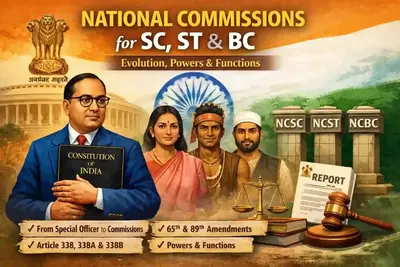
Introduction – Why This Commission is Important
Recently, the National Commission for Backward Classes (NCBC) recommended the removal of several Muslim and other communities from the Backward Classes List in West Bengal. This has Continued the recent debate about the purpose of constitutional commissions.
Social justice is a fundamental commitment to the people of India, contained within the Constitution itself.
Scheduled Castes (SCs), Scheduled Tribes (STs), and Backward Classes (BCs) have historically faced discrimination, exclusion, and unequal access to opportunities.
The Constitution sought to remedy this by creating means to ensure equality, both on paper and in practice. Over time, the Special Institutions established by the Constitution to promote Equality have developed into Constitutional Commissions with their own defined powers and functions.
The Constitution Commissions serve as:
- Guardians – Keeping track of constitutional protections
- Advisory – Providing advice and support to governments regarding policy
- Protecting the Rights of Vulnerable Groups from Dilution.
Historical Development – From Special Officer to Commission
The Constitution of India (1950) established the office of the Special Officer for SCs & STs. Article 338 provides for the appointment of a Special Officer for SCs and STs.
- The Government of India appoints only one Special Officer.
- The Special Officer is an Individual mechanism to administer safeguards, not a Commission-like structure.
- The Special Officer is responsible for conducting investigations into the protection given to SCs and STs through the Constitution, and then for submitting the reports to the President of India.
Limitations of the Special Officer include:
- No Independent Authority, and
- No Quasi-Judicial Powers, and
- Dependent on Executive Actions.
1987 Commission– The Government established the 1987 Commission through a resolution, without giving it constitutional status. Its existence represented the first step toward institutionalise social justice monitoring.
The Commission’s responsibilities were more extensive than those of merely gathering reports. With the onset of the 1987 Special Officers’ Commission system, it became more into an advisory capacity. At this stage, the government introduced a multi-member Commission.
(a) There were no constitutional protections under the Commission structure. The absence of these protections made it less effective than it might be.
The 65th Amendment Act, 1990
The 65th Amendment Act, 1990 added a constitutional layer of oversight to the Special Officer and Commission systems and established several new key features to the constitutional framework for the monitoring of social justice.
89th Amendment Act, 2003
The 89th Amendment Act, 2003 provided Parliament with a greater ability to define the distinct needs of SC and ST communities, while at the same time providing for the establishment of separate Constitutional Commissions.
The establishment of the National Commission for Scheduled Castes (under article 338 of the Constitution) and to establish the National Commission for Scheduled Tribes (under article 338A of the Constitution) allowed for a more effective and comprehensive oversight of SC and ST communities. This bifurcation allows for the proper creation of safeguards and recommendations for SC and ST communities.
As a result of these two changes, there is now an equality between SC and ST.
Know more about other Constitutional Bodies from here – Election commission , UPSC, SPSC & more.
National Commission for Scheduled Castes (NCSC)
The National Commission for Scheduled Castes (NCSC), established under Article 338 of the Indian Constitution, is a body that protects the rights and interests of Scheduled Castes.
Composition
The Commission consists of:
- A Chairperson,
- A Vice-Chairperson, and
- Three 3 other Members.
As per its original provision in the Constitution of India, the Commission also included representation for the Anglo-Indian community, demonstrating the Constitution’s commitment to inclusiveness.
Appointment Process
- The Chairperson, Vice-Chairperson and other Members of the NCSC are appointed by the President of India.
- They are appointed by warrant issued by the President, and signed by the President.
Tenure and Reappointment Procedures:
- The NCSC members serve for a period of three 3 years.
- Members can be reappointed for 2 terms only.
- The President prescribes the terms and conditions of service for the Members.
5.4 Functions of the NCSC:
The NCSC has a dual role of investigation (monitoring) and advisory functions. The roles of the NCSC include, but are not limited to:
- The investigation and monitoring of the implementation of, and compliance with constitutional and legal protections and safeguards provided to Scheduled Castes;
- The investigation of a specific complaint alleging a violation of the rights or protections of Scheduled Castes;
- Advising the Union Government and the State Governments on the socio-economic development of Scheduled Castes and the formulation and implementation of public policy regarding Scheduled Castes;
- Participating (on behalf of Scheduled Castes) in the planning process for the development of Scheduled Castes, and evaluating the progress of development of Scheduled Castes.
Powers of the NCSC:
For the purpose of investigation, the Commission has the same powers as a civil court, including the power to:
- Summon individuals to appear before the Commission;
- Compel individuals to produce documents before the Commission; and
- Examine witnesses.
Annual Report
- The Commission submits an annual report to the President of India
- The report is laid before Parliament
- A mandatory Action Taken Report (ATR) explains the steps taken by the government on its recommendations
National Commission for Scheduled Tribes
The NCST is responsible for promoting and protecting the rights of Tribals and other Scheduled Tribes (STs). This includes the protection of Tribal Rights through recognition of Forest Rights, as well as the prevention of Alienation of Land.
The NCST also has an important role in the development of Tribals via both the Panchayati Raj Act (PESA) and by providing safeguards to members of PESA through the Constitutional provisions in the Fifth and Sixth Schedules of the Constitution.
Composition of NCST
- The NCST is composed of a Chairperson, a Vice-Chairperson and three other Members.
- All Members are appointed by the President of India and serve for a period of three years with the option of re-appointment.
Additional Responsibilities of NCST
The NCST has the additional responsibility of advising Governments-
- In matters of Tribal Self-Governance
- The protection of Tribal Culture, Customs and Traditional Knowledge
- The safeguarding of Natural Resources of Tribals
- And to ensure that the Development Process does not erode the identity of Tribals.
National Commission for Backward Classes
The National Commission for Backward Classes (NCBC) is instrumental in ensuring adequate representation and ensuring the welfare of the Classes.
The NCBC was established in 1993 with the promulgation of an Act of Parliament.
The Commission was established in view of the landmark decision of the Supreme Court, the Indra Sawhney case of 1992 in which the court:
- upheld a 27 percent reservation for OBCs
- highlighted the need for a body of experts to assess the status of the Backward Classes
The NCBC at this stage did not have the status of a Constitutional body.
Constitutional Body
The National Commission for Backward Classes has been made a Constitutional Body under the 102nd Constitutional Amendment to the Constitution which came into effect in January 2018.
As part of this Amendment, a new Article 338B was added to the Constitution.
The NCBC now has the same status and authority as the NCSC and the NCST.
Membership
The NCBC shall consist of:
- One Chairperson
- One Vice-Chairperson
- Three other Members
All of the Members are appointed by the President of India.
Functions
The NCBC performs both advisory and investigatory functions. Its functions include:
- Review of requests for the inclusion or exclusion of communities to the list of Backward Classes
- Advising the Central Government on the welfare and development of Backward Classes
- Investigating complaints regarding violations of rights and protections of Backward Classes
- Evaluating the effect of policy on the Backward Classes
Comparison
| Feature | NCSC | NCST | NCBC |
|---|---|---|---|
| Constitutional Article | 338 | 338A | 338B |
| Year of Formation | 2004 | 2004 | 2018 |
| Nature | Constitutional | Constitutional | Constitutional |
| Focus Group | SCs | STs | BCs |
UPSC Prelims PYQs (Last 10 Years – Theme-Based)
Frequently Asked Areas:
- Article numbers of constitutional commissions
- Which amendment created or bifurcated commissions
- Powers equivalent to a civil court
- Appointing authority of Chairperson and Members
- Submission of annual reports and Action Taken Reports
- Functional differences between NCSC and NCST
- Constitutional vs statutory bodies
- Role and powers of NCBC after the 102nd Constitutional Amendment
Importance of these Commissions
The Commissions constitute a link between the government and marginalized communities; they are also an accountability mechanism for what the Constitution guarantees. Additionally, these Commissions provide a formal voice for those historically excluded from governmental processes.
Ultimately, these Commissions will assist in achieving:
- Directive Principles of State Policy.
- Fundamental Rights, particularly in regard to equality and dignity.
Conclusion
The formation of these Commissions has reflected India’s increasing commitment to build an inclusive form of governance.
The development of multiple Constitutional Commissions from one Special Officer demonstrates the evolution of an institution which has matured over time but continues to face several challenges, including:
- The gaps between the intent of the Constitution and actual implementation of Constitutional promises
- The lack of strong enforcement of Recommendations made by the Commissions
- Delays by the Government in acting upon Reports submitted to it by the Commissions
Strengthening these Institutions is vital to converting the Ideals encompassed in the Constitution into a real-world manifestation of Social Justice.
Frequently Asked Questions
Q1. Which amendment separated the NCSC and NCST from each other?
A1. 89th Constitutional Amendment Act of 2003
Q2. Are the Commissions considered to be a Judicial Body?
A2. No, the Commissions are not classified as a Judicial Body but possess powers akin to a Civil Court.
Q3. Who has the authority to appoint Members to the NCSC/NCST/NCBC?
A3. The President of India.
Q4. Is NCBC considered a Constitutional Body?
A4. Yes, as per the 102nd Constitutional Amendment Act of 2018, NCBC is considered a Constitutional Body.
Q5. To whom does the Commission submit its Reports?
A5. The Commission submits Reports directly to the President of India.