Introduction –NASA space Missions
NASA (National Aeronautics and Space Administration) is at the helm of space exploration around the globe — searching for answers to humanity’s deepest questions about how the cosmos evolved, the formation of planetary systems, and the search for life in our universe.
Beyond the expansion of scientific knowledge regarding the solar system and universe, NASA missions promote international collaboration, advances in technology, and frameworks for space governance that will help shape the future of human presence beyond earth.
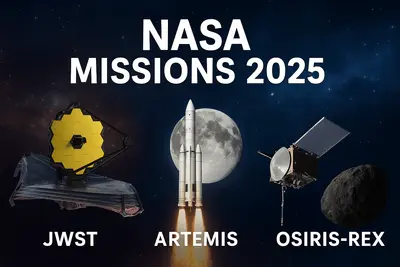
2025 is a transformative time for NASA:
- The Artemis Program will return people to the Moon.
- The James Webb Space Telescope (JWST) will examine the cosmos like it has never been seen before.
- The OSIRIS-REx mission will transition to a new asteroid target that will help scientists understand the formation of the solar system.
Astronomers recently discovered a new space object called “Atlas 3I”, that came remarkably close to the Earth – first discovered by the ATLAS survey from Hawaii – prompting discussions around global systems for following asteroids and planetary defense.
India, too, recently developed GSAT-7R, its heaviest military communication satellite – this shows how global space ambitions, NASA included, increasingly involve strategic and communication technologies.
James Webb Space Telescope (JWST)
Launched: December 25, 2021
Mission: Explore the universe’s past and grab light from some of the first galaxies created after the Big Bang.
Key Objectives
- First Light: Look for the universe’s first stars and galaxies created.
- Galactic Evolution: Look for signs of how galaxies merge and grow in size.
- Star & Planet Formation: Observe dust clouds forming new stars.
- Clues to Life: Examine atmospheres of exoplanets for organic molecules.
Capabilities
- 6.5-meter mirror with gold coating constructed out of 18 segments for maximum light collection.
- Ability to observe in infrared and look at cosmic dust.
- Location: Lagrange Point-2 (L2) approximately 1.5 million km from Earth.
- Five-layer sunshield to maintain very low temperatures (~–223 °C).
New Findings
- Found massive baby galaxies that existed a mere 300 million years after the Big Bang.
- Found carbon-based molecules on exoplanets that may be precursors to life.
- Mapped cold star-forming regions in the Milky Way in particular detail.
Want to understand how trade and technology policies impact outer-space cooperation?
Read our analysis on Tariffs on Earth Satellites in Space: India–USA Relations (UPSC)
Artemis Programme – Humans Return to the Moon
Mission: Land the first woman and next man on the Moon and establish the foundation for a sustainable base of operations for future human missions to Mars.
Phases
- Artemis I (2022): Uncrewed test flight of the SLS rocket and Orion spacecraft.
- Artemis II (planned for 2026): First crewed lunar orbit mission.
- Artemis III (target 2027): Crewed landing near the Moon’s south pole, an area abundant in water kandidaat.
- Artemis IV (post-2028): Developing the Lunar Gateway, a small station orbiting the Moon.
Global Cooperation
Involves ESA (Europe), JAXA (Japan), CSA (Canada), and commercial partners, such as SpaceX and Blue Origin.
Goal of fostering sustainable habitation on the Moon through using local resources, solar power, and extracting oxygen from the regolith.
2025 Highlights
- All Artemis II astronauts are in their final round of training, while integrations for the spacecraft are now at the finish line.
- The modular components of the Lunar Gateway are in the course of radiation survivability tests and ensuring life-support sustenance.
OSIRIS-REx and OSIRIS-APEX
Mission Type: Sample-return & Asteroid Exploration
Launched: 2016, Sample Returned: September 2023
NASA’s OSIRIS-REx mission was mankind’s first attempt to return samples from an asteroid – Bennu, which is thought to have material from the early days of the solar system.
Aims
- Investigate star-like asteroid Bennu, which is carbon heavy and filled with organic molecules.
- Representation of the origins of life and the formation of the solar system.
- Collect samples from the surface in order to analyze chemically and isotopically.
Mission Continuation – OSIRIS-APEX (Apophis Explorer)
After dropping Bennu’s sample capsule to the Earth in 2023, the spacecraft changed course and was designated OSIRIS-APEX.
It will engage in the exploration of asteroid Apophis, which is going to pass unusually close to the Earth in 2029, within the orbit of geostationary satellites.
- The mission will:
- Observe the way that the gravity from Earth modifies the surface of Apophis and how it spins.
- Investigate the regolith (soil) structure , and cratering.
2025 Developments
- In late September 2025, it executed a significant Earth flyby, which helped adjust our trajectory.
- Instruments on the spacecraft were also recalibrated for surface imaging and spectral mapping.
- Preliminary thermal imaging indicates that Apophis may have loose gravel-like material, similar to that found on Bennu.
Other Notable NASA Missions
| Mission | Launch Year | Objective | 2025 Update |
|---|---|---|---|
| Parker Solar Probe | 2018 | Study the Sun’s corona and solar wind | Completed 17th solar flyby; yielded new insights into solar magnetic field reversals. |
| Perseverance Rover (Mars) | 2021 | Search for ancient microbial life; collect samples | Continuing sample caching; joint ESA return mission delayed to 2033. |
| Juno (Jupiter) | 2016 | Study Jupiter’s atmosphere and magnetosphere | Captured high-resolution images of Io’s volcanic eruptions and lightning activity. |
| Nancy Grace Roman Telescope | Planned 2026 | Map dark matter, detect exoplanets, and conduct wide-field surveys | 80% assembly complete; scheduled for late 2026 test launch. |
Space Governance & International Cooperation
| Treaty | Year | Focus |
|---|---|---|
| Outer Space Treaty | 1967 | Space is free for all; must be used for peaceful purposes only. |
| Rescue Agreement | 1968 | Obligation to assist astronauts in distress. |
| Liability Convention | 1972 | States are liable for damage caused by their space objects. |
| Registration Convention | 1976 | Maintain registry of launched objects. |
| Moon Agreement | 1979 | Moon as the common heritage of humankind (India has not ratified). |
Want to understand how trade and technology policies impact outer-space cooperation?
Read our analysis on Tariffs on Earth Satellites in Space: India–USA Relations (UPSC)
Artemis Accords (2020–Present)
The Artemis Accords describe a voluntary framework by which nations will participate in peaceful exploration of the Moon, Mars and beyond.
Emphasis of the Accords include:
- Openness in activities.
- The sharing of scientific data.
- Interoperability with partner nations.
- The protection of historic sites (for example: Apollo landing sites).
By 2025, more than 43 nations support and have signed onto the Accords, including India, which signed in 2023.
Critics have labeled the Artemis Accords a US-centric initiative, but it is seeking clarification and cooperation amongst nations in lunar governance.
UPSC Relevance & Past Year Question Trends
| Theme / Topic | UPSC Relevance | Sample / PYQ Style Questions |
|---|---|---|
| Space Missions & Discoveries | Highlights technological innovation, global collaboration, and India’s participation in international space research. | Prelims 2023: “With reference to space technology, consider the following pairs – Mission and Objective. Which of the pairs are correctly matched?” |
| Infrared Astronomy (JWST) | Useful for understanding advancements beyond optical telescopes; connects physics, astronomy, and observational techniques. | Possible Q: “Why is infrared radiation preferred for studying early galaxies?” |
| Lunar Exploration (Artemis) | Links with India’s Chandrayaan-3 and ISRO’s upcoming Gaganyaan crewed mission; reflects cooperation under Artemis Accords. | Mains 2024: “Discuss how global lunar programs shape India’s space ambitions.” |
| Asteroid Missions (OSIRIS-REx & APEX) | Demonstrates planetary defense efforts and study of early solar system materials. | Possible Q: “What is the importance of sample-return missions for planetary science?” |
| Space Governance & Treaties | Frequently asked in Science & Tech and International Relations; key for understanding global space law. | Prelims 2019: “The term ‘Outer Space Treaty’ is related to— (a) Nuclear disarmament (b) Peaceful use of space (c) Maritime law (d) Biodiversity conservation.” (Ans: b) |
| Artemis Accords & India’s Role | Integral to India–US cooperation in space diplomacy and governance under peaceful exploration principles. | Expected Q: “Evaluate India’s decision to join the Artemis Accords in the context of space governance and strategic autonomy.” |
Conclusion
From the James Webb Telescope taking a picture of the light from the first galaxies in the Universe, to Artemis getting ready to put humans back near the Moon, NASA missions show the unlimited nature of human curiosity.
Every mission- whether we are exploring asteroids, stars, and far-off planets, add to scientific discovery while also creating international collaboration and even policy development in space governance.
After all, exploring space isn’t just to see if there is life out there, it’s about understanding our universe a little better, promoting peace, and improving life down here on Earth.
FAQs on NASA’s Space Missions 2025
1. What is NASA’s Artemis program?
The Artemis program aims to return humans to the Moon and establish a long-term lunar base as a step toward future Mars missions.
2. What is special about the James Webb Space Telescope (JWST)?
JWST captures light from the universe’s earliest galaxies, helping scientists study the birth of stars and planets in deep space.
3. What did OSIRIS-REx achieve?
OSIRIS-REx collected samples from the asteroid Bennu and returned them to Earth in 2023, offering clues about the solar system’s origins.
4. What are the Artemis Accords?
The Artemis Accords are an international agreement that set peaceful and transparent rules for space exploration and resource use.
5. What’s NASA focusing on in 2025?
In 2025, NASA is emphasizing lunar missions, deep-space research, and advancing technologies for Mars exploration.