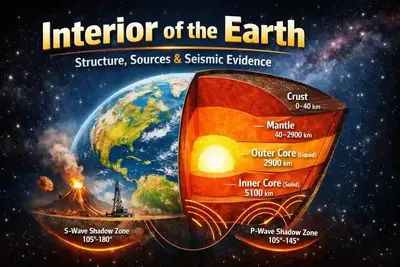
With the growing demand for Rare Earth Materials (REMs) like Neodymium, Lithium, Cobalt, Nickel, Chromium and their Metallic counterparts, it has become more important than ever to understand the Earth Interior.
The Earth’s interior is defined as the expansive geographic location of the Earth that extends from the Earth’s surface an average depth of approximately 6400 Kilometers to the Earth’s core, however the Layers making up the Earth have distinct compositions and temperatures and are not uniform throughout.
The information that we have on the Earth’s interior has mostly been determined through Indirect and Inferential means, as mankind can only explore and research below the Earth’s surface to depths of over several kilometers through Mining and other means, such as drilling and exploratory ocean expeditions. Consequently, we must study the Interior of the Earth to ensure that we can maintain a secure and sufficient supply of these valuable materials.
Interior of the Earth
Based on Composition
| Layer | Minerals | Density |
|---|---|---|
| Crust | Sial / Sial + Sima | 2.7–3 g/cm³ |
| Mantle | Sima | 3.3 g/cm³ |
| Core | Nife | 13 g/cm³ |
Based on Physical State
1. Lithosphere – The Outer Rigid Layer of the Earth
- The lithosphere is the outer rigid layer of the Earth.
- The lithosphere is the upper rigid layer of the Earth.
The Lithosphere Includes:
- Crust (both oceanic and continental)
- Uppermost solid portion of the mantle
Average Thickness:
- Approximately one hundred kilometers
- Thicker below continents and thinner below oceans
Key Characteristics:
- Hard
- Brittle
- Rigid
- Broken into plates
- Floats on the asthenosphere
Relevance to UPSC:
- Earthquakes and volcanoes occur at plate boundaries
- Provides a basis for the plate tectonic theory
2. Asthenosphere – Semi-Molten and Plastic Layer
- The asthenosphere is a semi-molten and plastic layer.
- The asthenosphere is located beneath the lithosphere and is located in the upper mantle.
Depth Range:
- From approximately 100 km to 400 km below the Earth’s surface
Key Characteristics:
- Semi-molten and plastic nature of the rocks
- Rocks at this location are solid but behave like a viscous fluid
- Low seismic wave velocity region
Role of the Asthenosphere in Moving Plates:
- Lithospheric plates float on the asthenosphere
- Convection currents also originate from the asthenosphere
Relevance to UPSC:
- Explains plate movement
- Explains volcanic activity
- Explains mid-ocean ridges
3. Mesosphere – Lower Mantle (Rigid Due to Pressure)
- The mesosphere is the lower mantle.
- The mesosphere lies beneath the asthenosphere and extends to the Earth’s core.
Depth Range:
- From approximately 400 km to 2900 km
Key Characteristics:
- Composed of solid mantle material
- Remains rigid though high in temperature due to high pressure
- Density increases with depth
Relevance to UPSC:
- Transmits seismic waves richly well
Significance of Critical Minerals
- Countries like India are focusing on critical mineral security to reduce dependence on imports.
- Deep-sea mining, mantle-derived minerals, and exploration of oceanic crust are being discussed globally.
- UPSC increasingly links physical geography with economic and strategic geography.
- Thus, the study of Earth’s interior is no longer just academic—it is economically and geopolitically significant.
Sources to Study the Interior of the Earth
Since direct access to the Earth’s interior is extremely limited, geographers and geologists rely on both direct and indirect sources.
A. Direct Sources
| Source | Maximum Depth | Example |
|---|---|---|
| Volcanoes | 400–700 km | Lava brings mantle material to surface |
| Mining | ~4 km | Deepest mine in South Africa |
| Drilling | ~12 km | Arctic deep drilling |
| Oceanic trenches | ~11 km | Challenger Deep, Mariana Trench |
These sources provide actual samples of rocks and minerals and help in understanding the composition of the upper layers of the Earth.
Limitations of Direct Sources
Direct methods can span a very limited distance—approximately 400 km into the Earth at most—as direct sources have proven ineffective for gaining knowledge of the rest of the Earth’s interior. Approximately 6000 km into the Earth’s interior cannot currently be accessed. The extreme temperature, pressure, and molten state of the Earth’s interior environments prevent any human access to this area.
For this reason, direct sources are not sufficient to explain the Earth’s internal structure completely.
| More on Direct sources: Volcanoes (400-700 Km)Mining (4 Km) – For example – the deepest mine in South Africa which is approximately 4 km deep. Drill (12 Km)- For example – the deepest drill is the Arctic drill which is approximately 12 km deepOceanic trench (11 Km)- For example – Challenger Deep of the Mariana trench |
B. Indirect Sources
Because of the limitations of direct methods, scientists utilise other means—i.e., indirect methods—to infer information about the Earth’s internal structure. The major sources of indirect data available are:
- Physical properties of the Earth
- Seismic waves
- Gravitational and magnetic studies
- Space Objects
1. Physical properties of the Earth
These indirect measures allow scientists to determine the way in which the Earth’s internal structure is composed of different materials.
Temperature:
- The temperature rise is 1°C for every 32-meter depth.
- By this calculation at the centre, the temperature should be 2 lakh degrees Celsius but other studies have confirmed that the actual temperature at the centre is not more than 5500°C.
- Hence, This example highlights one of the reasons direct measures cannot increase temperature uniformly as each time you descend deeper into the Earth, you will find that the physical state of the material you are measuring will change, and subsequently the temperature you would have calculated may not be uniformly higher than that at the surface.
Density
- The density of the earth can be calculated using gravity equations and the measured gravity on the earth. This way, the average density of the whole earth is found to be around 5.5 gm/cm3
- Continental rock has a density of 2.7 gm/cm3 and oceanic rock has a density of 3 gm/cm3
- The calculated density at the centre of the earth is around 13 gm/cm3 for the overall average to be 5.5gm/cm3
Pressure
Pressure is measured in the Earth’s interior along with Temperature and Density.
- As the depth of an object increases below the surface of the Earth, the amount of pressure on that object increases substantially.
- Temperature, Density and Pressure are measured in the laboratory through laboratory testing.
Therefore, By replicating conditions in the laboratory to simulate pressure within the Earth, scientists can determine which minerals could potentially exist based upon temperature and density.
Through laboratory testing:
- The Core of the Earth consists of Nickel, Iron and Chromium.
- The Upper Layers of the Earth consist of Silicon, Aluminium and Magnesium.
- The findings from laboratory testing of minerals provide insight as to why the Strategic and Rare Earth Elements that are associated with deep-seated geological processes.
2. Space Objects
Space Objects Provide a Means to Gain Insight into the Interior of Earth. Reasons to Research Space Objects:
- The study of space objects has been completed because during the formation of the Solar System
- Many of the Earth and other celestial objects were created from the same primordial material
- Therefore the composition of space objects can be used to provide insight as to what the Earth was made from, particularly those components that were not visible at the surface.
Most Important Sources of Information on Earth’s Interior
- Meteoroids: Meteoroids can provide us with actual examples of material that has originated from outer space.
- Space Missions: The analysis of the elemental compositions of celestial bodies is accomplished through space missions, and enable the examination of celestial bodies that contain similar characteristics to Earth.
Meteoroids and Space Missions provide the best opportunity to examine:
- Elements that are Rare or Not Present in the Surface of Earth
- The Possible Metallic Component of Deeper Layers of the Earth
Key Terms
- Meteoroid – A body moving through space.
- Meteor – A meteoroid which is now in the Earth’s atmosphere.
- Meteorite – A meteoroid that has landed on Earth’s surface.
Meteorites are especially significant because many times they contain iron, nickel, and rare earth elements, which support the concept that the Earth’s core is made up of metals.
Limitations of Space Objects
- They can tell us what something is made of only.
- They do not provide detailed information on how the Earth is layered, how thick each layer is, or what layer comes before/after the one before it.
- Thus, space objects can only be used to support Earth’s internal structure, not to independently provide insight.
3. Gravitational and magnetic studies
We can study the forces that the Earth generates from within to gain insight into what the interior of the Earth looks like.
(a) Gravity
The gravitational field of the Earth does not remain constant all over the planet.
The gravitational anomalies are where one rectangular area of the Earth has a different amount of gravity than another rectangular area. Gravitational anomalies provide information about:
- The density of what lies underneath Earth’s surface;
- The difference between the density of heavier/superdensed materials versus lighter/less dense materials lying beneath the surface;
Thus, by studying the measurement of gravity, we are able to gain insight into the density of materials situated within the Earth.
(b) Magnetic Force
The Earth acts as a big magnet due to the presence of certain metals (like iron/nickel) that produce magnetic fields. By studying variations in the Earth’s magnetic field:
- Scientists infer the metallic nature of the core
- It supports the concept of a nickel–iron (NiFe) core
Magnetic studies strongly complement seismic evidence.
4. Earthquakes and Seismic Waves
“Seismicity” is the releasing of energy when large blocks of rock move on top of each other, which are then projected as seismic waves across the planet. The production process and physical behavior of the seismic waves give geologists evidence-based data on how the Earth is structured internally. We go into greater detail of how this happens in a later post.
Types of Seismic Waves
- Body Waves (Seismic Waves that Move through the Interior of Our Planet)
a) P-waves: Fastest, longitudinal & can propagate through all of the Earth (solid rocks, gases, and liquid substances).
The P-wave is usually the first seismic wave to reach a seismologist (the fastest) and is considered useful in determining how strong the earthquake was.
b) S-waves: Slower, transverse, & can only propagate through solid rocks.
The S-wave is critical for identifying areas of a liquid layer.
2. Surface Waves:
These waves are generated when body waves reach the Earth’s surface. Surface waves are responsible for the vast majority of damage from earthquakes because they can cause the most intense ground shaking.
Shadow Zones and Their Implications
S-wave shadow zone (105°–180°): The lack of S-waves at this point of the globe confirms that a portion of the Earth has an outer liquid core.
P-wave shadow zone (105°–145°): The shadows occur as a result of the refraction of P-waves within the core, implying:
- Variations in density
- Existence of solid inner core
Additional facts for Determining the Depth of the Earth’s Interior:
- Liquid outer core ≈ 2900 km deep
- Solid inner core ≈ 5100 km deep
Seismic waves have the unique ability to provide scientists with the best evidence of the internal structure of the Earth through a series of layers.
Conclusion
The study of the interior of the Earth reveals that what lies beneath the surface controls earthquakes, volcanoes, plate movements, and even the distribution of critical and rare earth minerals. Although direct access is limited, indirect methods—especially seismic waves—have helped scientists decode the Earth’s layered structure. In the current era of energy transition, mineral security, and disaster preparedness, this topic holds both academic and strategic importance for UPSC aspirants.
FAQ’s
Extreme temperature & pressure beyond asthenosphere
Asthenosphere
High density elements sank during Earth’s formation
Surface waves
Due to movement of molten iron in outer core


Informative