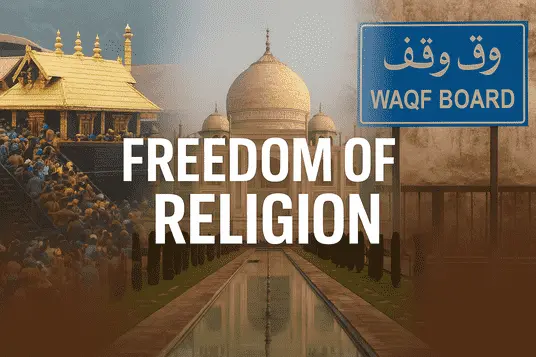
In a country of a thousand different faiths, the Constitution of India serves as the only strand that weaves them together. Whether it is the case on whether women can enter the Sabarimala temple, the Waqf Board property cases, or the recent film claims regarding “The Taj Story” about the Taj Mahal having once served as a temple, the balance between faith and fact continues to be the ultimate test of India’s secularism.
Articles 25-28 create the spiritual core of the Constitution, enforcing freedom of religion but holding the balance of state shrouded in secularism. The state remains neutral in faith and not indifferent – the duty of the state is to step in when faith collides or even interferes with equality or morality and public order.
At its essence, India’s secularism is not the denial of religion, rather it creates a space for every belief to exist on the same constitutional sky.
Article 25: Freedom of Conscience and Free Profession, Practice, and Propagation of Religion
Article 25 guarantees the freedom of all individuals and their right to religious belief – the freedom of conscience to believe, practice and propagate faith.
It relates to citizens and non-citizens but is simultaneously governed by public order, morality, health and/or other fundamental rights. It supplements Article 25 as it accepts that belief is not merely personal but often expressed in a communal setting.
According to this, Every religious denomination has the right, subject to public order, morality and health:
- To establish and maintain institutions for religious and charitable purposes.
- To manage its own affairs in matters of religion.
- To own and acquire property.
- To administer such property mentioned in accordance with the law.
Test for Religious Denomination (Shirur Mutt Case, 1954):
- A name,
- An organization, and
- A common or shared belief relating to the spiritual welfare of its followers.
Read about Freedom of Speech & Expression shapes Freedom of Religion.
Philosophical Foundations of Religious Freedom: the Indian & European Philosophers
Religious freedom is not just a modern legal concept — it has deep roots in ancient philosophical thought, both in India and in Europe. Understanding these encounters allows us to see how the constitutional rights specified in Articles 25 to 28 are anchored in centuries of ethical considerations.
Indian Philosophers
1- Chanakya (Kautilya, 4th century B.C.E.)
- Argued for religious tolerance, which he saw as essential for social order.
- Saw the State as responsible for maintaining harmony between mutliple religious communities, even while advancing Dharma (moral order).
2- Buddha (6th-5th century B.C.E.)
- Promoted freedom of thought and inner conscience.
- Encouraged voluntary religious practice based on reason as opposed to coercion.
3- Mahavira (Jainism, 6th century B.C.E.)
- Promoted Ahimsa (non-violence) of thought and action, others faiths included.
- Advocated coexistence with respect for each other’s beliefs.
4- Bhakti & Sufi Saints (Medieval period)
- Prominent figures such as Kabir, Guru Nanak, and Chaitanya promoted the primacy of personal devotion over ritualistic conformity to religion.
- They argued that spiritual freedom transcended caste and creed regardless of institutionalized religion.
European Philosophers
1- John Locke (17th century)
- Argued for the separation of Church and State.
- Argued belief is a personal matter with no other person having jurisdiction over the conscience.
- His arguments laid the foundation for modern concepts of religious liberty in liberal democracies.
2- Voltaire (18th century)
- He supported free speech and wanted religious tolerance.
- He is known for saying, “I disapprove of what you say, but I will defend to the death your right to say it.”
3- Montesquieu (18th century)
- He endorsed laws that recognize the diversity of religious beliefs.
- The separate branches of government are an assurance that the State cannot impose one religion over another.
Therefore, From Chanakya to Voltaire, the philosophy of freedom of religion insists on three emphases:
- Respect for individual conscience
- Vaunted tolerance of diversity
- State neutrality regarding matters of faith
Articles 25-28 of the Indian Constitution incorporate these timeless values into a constitutional scheme. They provide a framework for balancing individual freedoms, collective denominational rights, and the state’s obligation to toleration and secularism.
Landmark Case: Indian Young Lawyers’ Association v. State of Kerala (Sabarimala Case, 2018)
The Sabarimala Temple denied entry to women of a certain age (between the ages of ten and fifty), citing that the deity, Lord Ayyappa, was Nazarene.
Temple’s Argument: Claimed protection under Article 26 for a religious denomination to manage its religious affairs.
Supreme Court Decision:
Majority: Violation of Articles 15 and 25-denied women’s right to worship.
Minority (Justice Indu Malhotra): It was an essential religious practice entitled to protection under Article 26.
Current Status: Under Article 137, the decision is pending in front of a larger constitutional bench.
Waqf Board and “The Taj Story” — Where Faith Intersects Law and History
The issue arising from the Waqf Board case (2024–25) involved, once again, the question of whether the State may regulate religious properties.
The Supreme Court commented that while Article 26(d) accords a denomination the right to “manage its own affairs in relation to … property”, this management must occur “in accordance with law” — thereby creating a constitutional benchmark for transparency, accountability, and fairness.
The Taj Story, and the claim that the Taj Mahal was a temple, represents an additional boundary — do historical narratives informed by faith allow for the reimagining of secular governance in the years to come?
Just as the Waqf Board cannot escape owing a duty to law, neither can any narrative — being religious or political — claim to re-narrate history as fact, on behalf of any account of either.
Both debates surrounding religious ownership of property and specifically religious narratives of monuments express the same constitutional imperative:
Faith may fuel belief, but law must carve out fact.
Hence, Article 26 is an example of India seeking to find a balance — to provide a denomination autonomy but within constitutional boundaries.
From the temple gates of Sabarimala, to the land records of Waqf, to the marble walls of the Taj Mahal, one lesson emerges amidst the history:
Religion is free in India, but never free from law.
Article 27: Exemption from Taxation For Purpose of Advancement of Religion
Article 27 protects citizens from being compelled to pay taxes that are assigned for the benefit of any specific religion, which is vital to maintaining this neutral nature of the State’s approach to finances, ensuring that public funds are not spent to promote religious objectives.
Landmark Cases:
Commissioner, Hindu Religious Endowments, Madras v. Sri Lakshmindra Thirtha Swamiar of Shirur Mutt (1954): This case addressed the classification of religious expenditure. The Court clarifies, that while expenditures that are directly in relation to the practice of religion or the administration of temples are subject of regulation, it does not justify the expenditure of public tax dollars to promote religion.
Ramchandra v. State of Orissa (1954): The Court states that a fee charged for providing facilities to the religious institution is not a tax for the purposes of Article 27.
This Article represents the principle that the State’s treasury shall be neutral and, therefore, protects those with faith, and those without faith, from government monetary support of a religious institution
Article 28: Exemption from Religious Instruction in Schools
Article 28 protects the secular nature of educational institutions by regulating religious instruction in public or private school settings:
- 28(1): Prohibits religious education in institutions entirely funded by the State.
- 28(2): Allows religious education in institutions established by charity or trust.
- 28(3): Institutions funded by the Public Authority can offer religious education only with the consent of the student or, if a minor, the consent of the guardian.
Example: A State-funded school can teach Jainism or Buddhism as part a course on culture and history, but a course on religious proselytizing or devotion is prohibited.
Article 28 captures the Indian model of principled secularism – it does not reject religion, but mandates that the education sector is inclusive and neutral, must be free from coercion (between coercion and persuasion), neither advocates nor opposes any religious aspect.
Waqf Board and State Oversight (2024-25)
The Supreme Court has recently ruled on the powers of Waqf Boards, particularly in relation to their autonomy to manage properties. The core issue is whether the State’s oversight of religious property is an encroachment of the ‘freedom to manage religious affairs’ under Article 26(d).
Article 26(d) – promotes right of religious denominations to manage property. In other words, the State can regulate religious property as long as it does not interfere with practices which are fundamental to that religion, so long as the law allows a partnership to the misappropriation or adventure to mismanage.
Recent Observations: Court underscored – transparency, accountability, and good governance of Waqf lands.
Key Judgements
| Case | Year | Article(s) | Key Takeaway |
|---|---|---|---|
| Shirur Mutt Case | 1954 | 26 | Defined “religious denomination” & scope of autonomy |
| Rev. Stanislaus Case | 1977 | 25 | Right to propagate ≠ right to convert |
| Bijoe Emmanuel Case | 1986 | 25 | Protected conscience of Jehovah’s Witness students |
| Sabarimala Case | 2018 | 25–26 | Gender equality vs denominational rights |
| Ramchandra Case | 1954 | 27 | Fee ≠ tax; no violation |
| Waqf Board Case | 2024 | 26(d) | Regulation allowed, not interference |
These instances reflect an active balancing of freedom and accountability under India’s secularism framework. Just as the Sabarimala case represented a contest between the rights of denominations and individual equality, so too in the Waqf Board case, we see that religious freedom operates with boundaries to uphold principles of law, order, and morality.
Balancing Freedom and Responsibility: Are Articles 25–28 Absolute Rights?
Articles 25 and 26 are not absolute rights — they are qualified rights that depend on public order, morality, and health.
The State can regulate non-religious aspects of religion (Shirur Mutt Case, 1954).
The State can also identify essential religious practices (Durgah Committee v. Syed Hussain Ali, 1961).
These articles show us a dynamic secularism in action — public tolerance for faith practices creates room for fair, equal, and public interest, and ensures that faith does not outstrip public principle.
UPSC & Contemporary Relevance
UPSC PYQ’s on freedom of religion-
| Year | Exam | Question | Key Focus / Answer |
|---|---|---|---|
| 2019 | Prelims | Which statement regarding freedom of religion in India is correct? | Right of religious denominations to manage own affairs (Article 26); some minor communities excluded |
| 2018 | Prelims | Which Article guarantees freedom of conscience and right to freely profess, practice, and propagate religion? | Article 25 |
| 2016 | Mains | How does Indian secularism differ from the Western model? | Indian secularism allows state intervention to ensure freedom; Western model separates religion and state |
| 2013 | Mains | Significance of ‘essential religious practices’ doctrine in India? | Supreme Court decides which religious practices are protected under Articles 25 and 26 |
Conclusion: The Soul of India’s Secularism
“The Right to Freedom of Religion in India is not about faith in God — it’s about faith in coexistence.”
India’s Constitution envisions a nation where faiths differ but dignity remains equal. Articles 25–28 do not merely protect religion — they protect harmony. By balancing individual devotion with collective responsibility, the State ensures that religion enriches society, not divides it.
In essence, India’s secularism is not the absence of religion, but the presence of fairness — a reminder that our strength lies not in uniformity, but in unity through diversity.
FAQs: Freedom of Religion in India
Q1. What are Articles 25 and 26 about?
Article 25: Protects individual religious freedom – the right to believe, practice, and propagate.
Article 26: Protects collective rights of religious denominations – manage institutions, property, and affairs in religious matters.
Q2. Are Articles 25 and 26 absolute?
No, they are qualified rights. They operate subject to public order, morality, health, and other Fundamental Rights. The state can make laws regulating the secular aspects of religion while protecting the essential practices of religion (Shirur Mutt, 1954; Durgah Committee, 1961).
Q3. What rights does Article 27 provide?
Article 27 prohibits any citizen from being compelled to pay tax or fees for the promotion of any religion under the law, thus creating a secular funding of public funds.
Ramchandra v. State of Orissa (1954): Facilities fees are not taxes.
Q4. What does Article 28 of the Indian Constitution state?
Article 28 regarding secular education stipulates:
State-funded schools cannot teach religious instruction regardless of whether the school is in collaboration or partnership with a religious institution.
Schools funded by a trust or with some help can still impart religious instruction if the guardian of the child approves.
Providing instruction on every aspect of cultural teachings of religions (Jain, Buddhism, etc.) is not an exception.
Q5. What was the Sabarimala case?
Sabarimala temple, which prohibited women of a certain age from entering the temple. The Supreme Court had to balance:
Article 25: Women’s right to pray
Article 26: Collective denominational rights
Ruling: Majority can the ban; dissenting opinion still found it a valid essential religious practice. A review will earn consideration under Article 137.
Q6. What is the significance of the Waqf Board Case?
The Supreme Court evaluated the State’s regulation of Waqf properties:
Article 26(d) allows for administration as directed by legislation.
The SC emphasized the need for transparency, accountability, and management under the law while respecting important religious practices.
Q7. How does the Taj Story matter?
The assertion that the Taj Mahal was originally a temple raises the question about restricting the border between belief, historical recognition, and secular governance. It demonstrates that the freedom of belief or expression cannot supplant evidence or law, corresponding to ideas in Articles 25-28.


Informative