Introduction
India’s experience as a developing economy has shown that high fiscal deficits and rising public debt can fuel inflation, push up interest rates, and hinder long-term growth. To avoid fiscal mismanagement and ensure macroeconomic stability, a rules-based framework for fiscal discipline became essential.
The Constitution, under Article 112, mandates that the Annual Financial Statement (Budget) be presented to and approved by Parliament, ensuring transparency and legislative oversight over government finances. This constitutional requirement reflects the principle of fiscal prudence and accountability.
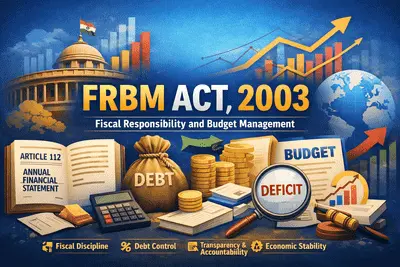
Against this backdrop, the Fiscal Responsibility and Budget Management (FRBM) Act, 2003 was enacted to provide a statutory framework for fiscal discipline, enhance transparency, and strengthen the credibility of India’s budgetary process.
Economic Conditions Leading to the FRBM Act
India’s fiscal position weakened in the 1990s as fiscal deficits and public debt rose without matching revenue growth. Rising government expenditure, growing subsidies, higher interest payments, and politically driven spending largely caused this deterioration. As a result, revenue deficits widened persistently, weakening the quality of public finances.
To finance these deficits, the government increasingly relied on borrowings, including deficit monetisation, which fuelled inflationary pressures. The 1991 Balance of Payments crisis exposed these weaknesses, as acute foreign exchange shortages forced India to undertake structural reforms. Although liberalisation improved growth prospects, fiscal indiscipline persisted due to the absence of a binding statutory framework for fiscal consolidation.
Learn about RCEP partnership of india – Click here!
International Influence
India’s shift towards formal fiscal rules was influenced by global experience. Countries such as New Zealand, the UK, and EU members adopted fiscal responsibility laws and deficit–debt limits, highlighting the advantages of rule-based fiscal management.
Additionally, institutions like the IMF and World Bank consistently emphasised fiscal discipline as essential for macroeconomic stability and sustainable growth.
Need for the FRBM Act
The FRBM Act was enacted to address India’s long-standing fiscal challenges by:
- Ensuring macroeconomic stability through controlled deficits
- Preventing unsustainable debt accumulation
- Enhancing the credibility and predictability of fiscal policy
- Reducing inflation caused by deficit financing
- Promoting intergenerational equity
- Improving transparency and accountability in budgeting
Overall, the Act sought to replace discretionary and short-term fiscal decision-making with a rules-based fiscal framework, strengthening India’s public financial management system.
Objectives of the FRBM Act
In general, according to the FRBM Act, all fiscal targets set forth in the legislation are intended:
- To establish a legal framework for institutionalizing fiscal discipline;
- Gradually reduce overall fiscal deficit and revenue deficits;
- Achieve sustainable, prudent debt levels;
- Allow for greater transparency in fiscal operations; and
- Increase parliamentary oversight of the government’s financial operations.
FRBM Act, 2003 (Chapter- & Section-wise Overview)
An overview of the structure of the FRBM Act, 2003 (i.e. an analysis of the chapters and sections) will be undertaken in other areas of this paper.
The preliminary provisions set forth in the FRBM Act identify the following features:
- The Fiscal Responsibility and Budget Management Act, 2003 is the official title of the Act.
- The FRBM Act applies to the entire territory of India.
- The FRBM Act became effective on the date specified in a notification from the Central Government.
Key Definitions:
To eliminate confusion regarding important terms associated with the Act, these key terms are defined as follows:
- Fiscal Deficits are defined as the total expenditure of the government less all non-debt receipts of the government.
- Central Government Debt is defined as all outstanding liabilities of the Union Government.
- General Government Debt is defined as the total liabilities of both the Centre and all State governments, excluding liabilities between or among governments.
- Fiscal Indicators are measurable targets by which to gauge the fiscal health of the government.
- Gross Domestic Product (GDP), and Real GDP, differentiate between nominal output of the economy and inflation-adjusted growth.
These definitions are the foundation upon which the Act is built conceptually.
A) Fiscal Policy Statement (Section 3):
Section 3 of the Act requires the Central Government to submit its key fiscal statements to Parliament each year with the Budget.
1- The Medium-Term Fiscal Policy Statement sets out a rolling target (three-year) for each fiscal indicator.
2- The Fiscal Policy Strategy Statement describes the government’s fiscal strategy and approach for the forthcoming year.
3- The Macro-Economic Framework Statement provides a broad economic outlook.
4- The Medium-Term Expenditure Framework Statement describes all medium-term spending commitments.
The issuance of these four fiscal policy statements will enhance Parliament’s oversight of the government and enhance fiscal disclosure.
This section sets enforceable fiscal rules: a 3% of GDP fiscal deficit ceiling, debt limits of 40% for the Centre and 60% for the General Government, restrictions on guarantees, and mandatory reporting of outcomes. An escape clause permits temporary deviations in exceptional cases, like national security threats or severe economic crises, while promoting counter-cyclical fiscal policy.
B) Prohibiting Central Government Borrowing from the Reserve Bank of India (Section 5)
Section 5 prohibits the Central Government from directly borrowing from the Reserve Bank of India to prevent inflation from deficit monetisation. The RBI may temporarily allow such borrowing through Ways and Wonderful. It can also act in primary and secondary government securities markets in limited cases to maintain monetary stability and its independence.
C) Fiscal Transparency (Section 6)
The Act mandates that:
The costs of preparing the budget will be made known; the government will make certain mandatory fiscal disclosures as per regulation; the government will be required to demonstrate public interest, transparency and accountability with respect to fiscal operations.
D) Compliance and Enforcement (Sections 7 and 7A)
Section 7 and Section 7A specifically prescribe measures to ensure compliance with the regulations in the Act. The Finance Minister of the government will conduct a review of the budget at least every six months. Each government will produce monthly accounts. Governments will be mandated to implement any monitoring measures to address revenue shortfalls and expenditure overruns. Compliance and enforcement will be monitored, and any deviations from targets will be reported to and require the approval of Parliament and the Secretary to the Treasury.
E) The FRBM Act’s Operational Aspects And Related Areas (Sections 8-13)
The FRBM Act, Sections 8-13, provide for various operational and institutional aspects regarding the implementation of the Act.
The Act empowers the Central Government to frame rules for implementing its provisions, including fiscal and expenditure indicators, formats of fiscal statements, and disclosure norms. This rule-making power provides flexibility and allows the framework to adapt to changing economic conditions without frequent legislative amendments.
To ensure democratic accountability, all rules must be laid before both Houses of Parliament and are subject to modification or annulment. The Act also protects actions taken in good faith by the Government and its officials.
Civil courts are barred from questioning actions under the Act to prevent judicial interference in fiscal policy. While the FRBM Act operates alongside existing laws without overriding them, it also grants the Government limited power to remove implementation difficulties, subject to parliamentary oversight.
Significance
The FRBM act is a significant element of India’s economic governance framework. It enhances macroeconomic stability by setting limits on deficits and debt accumulation. It creates clear fiscal targets, which provide fiscal policy with credibility and predictability required for long-term planning.
By restraining government borrowing to provide private investment an opportunity to grow, the FRBM Act allows for more extensive private-sector participation and improves investor confidence (both domestic and foreign). Furthermore, by mandating regular reports and legislative oversight, the FRBM Framework enhances democratic accountability. As such, the FRBM Act aligns fiscal policy with medium- and long-term fiscal objectives supporting sustainable rather than short-term populist growth.
Drawbacks of FRBM Act
However, the FRBM Act has received multiple criticisms despite its intentions. The stringent, numerical targets limit necessary government spending when an economy experiences a downturn or the effects of an economic crisis. Frequent use of the escape clause has further reduced the credibility of fiscal rules establishing cash balances. Additionally, by creating off-budget borrowing schemes, the government continues to use accounting methods that constitute an attempt to satisfy prescribed limits/targets established by the FRBM Act.
There are critics who contend that there is significant emphasis on reducing deficits through the FRBM, with little regard for the quality of public spending. Furthermore, they point to a lack of structural revenue reform initiatives and weak enforcement mechanisms.
Reforms and Evolution of the FRBM Framework
The FRBM has been amended multiple times over time due to future legislation adopted through Finance Acts. The N.K. Singh FRBM Committee recommended replacing strict deficit targets with a debt-focused fiscal framework.
Reforms promote counter-cyclical policies, giving flexibility during slowdowns and reducing debt during high growth periods.
This approach uses a more pragmatic view of the use of fiscal resources and the management of them.
Conclusion
The FRBM Act, 2003 remains a vital pillar of India’s fiscal framework, promoting fiscal discipline, transparency, and accountability in public finances. Although economic shocks and implementation challenges have affected its effectiveness, it continues to guide fiscal policy. Going forward, alongside strong commitment to transparency and accountability, the framework must allow calibrated flexibility, focusing on credible and sustainable fiscal practices rather than rigid adherence to numerical targets.
In the future, in addition to continued commitment to transparency and accountability by the Government, a significant focus should be placed on providing some flexibility, when appropriate, while the Government is working to achieve its fiscal plan in accordance with the adopted guidelines, rather than strictly adhering to maintaining numerical targets as established under the FRBM framework, along with credible and sustainable fiscal policies and practices.
UPSC PYQ’s
Q1- With reference to the Union Budget, consider the following statements:
- The Union Finance Minister lays the Annual Financial Statement before both Houses of Parliament.
- At the Union level, no demand for a grant can be made except on the President’s recommendation.
Which are correct?
(a) 1 only
(b) 2 only
(c) Both 1 and 2
(d) Neither
Answer: (c)
Q3- What is the difference between “vote‑on‑account” and “interim budget”?
(a) Only a caretaker government can present a vote‑on‑account
(b) A vote‑on‑account includes receipts and expenditure
(c) Interim budget deals only with expenditure
(d) Both are the same
Answer: (a)
Q4- Consider the following statements:
- Revenue expenditure does not create assets.
- Capital expenditure increases assets or reduces liabilities.
Which are correct?
(a) 1 only
(b) 2 only
(c) Both 1 and 2
(d) Neither 1 nor 2
Answer: (c)
Which one of the following is most inflationary in its effects?
(a) Repayment of public debt
(b) Borrowing from the public to finance a budget deficit
(c) Borrowing from banks to finance a budget deficit
(d) Creation of new money to finance a budget deficit
Answer: (d)
Q5- In the context of governance, which measure can be used to reduce fiscal deficit?
- Reducing revenue expenditure
- Introducing new welfare schemes
- Rationalising subsidies
- Reducing import duty
Select the correct answer:
(a) 1 only
(b) 2 and 3 only
(c) 1 and 3 only
(d) 1, 2, 3 and 4
Answer: (c)