Introduction
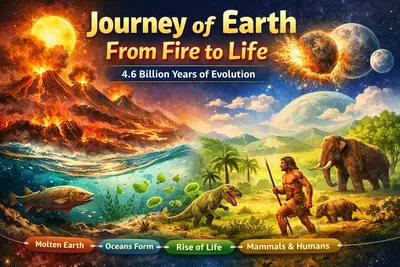
Earth is a 4.6 billion year old planet and has the honour of being one of the oldest planets in our solar system. At present, Earth is the only planet known to support life as we know it.
The Earth was not always the blue and green planet it is today.
Once upon a time, it was a blazing hot, fiery molten ball with no atmosphere, water, or way for life to exist.
This blog details:
- How Earth was created
- How oceans, continents and Earth’s atmosphere were created
- How life came to exist ONLY on Earth and NEVER on any other planet.
Big Bang Theory: Formation of the Universe
It is necessary first to learn about how our universe was formed before learning about how Earth was formed.
What is The Big Bang Theory?
The Big Bang is a theory that explains how the universe was formed. It suggests that:
The universe was created about 13.8 billion years ago from a very hot and dense area.
Then this area suddenly expanded to form:
- Space,
- Time,
- Matter,
- Energy.
This expansion process continues today.
The Formation of Galaxies, Stars, and Solar Systems
After the Big Bang occurred:
- Matter began coming together slowly because of the force of gravity.
- When enough matter was drawn together by the forces of gravity into one place, galaxies formed.
- Inside galaxies, stars were formed.
- Planets formed around some of those stars.
Our sun and solar system formed approximately 4.6 billion years ago from a cloud of gas and dust called the solar nebula.
The Connection Between The Big Bang and Earth
Earth was not formed until much later after The Big Bang occurred. Earth was formed, like all other planets in the universe, from materials that were created inside earlier stars.
The heavy elements:
- Carbon,
- Oxygen,
- Iron
were formed in great stars and then released during supernova explosions.
Therefore, the materials we are made of and the materials that make up the earth are the same as the materials that are formed by stars.
How Significant is The Big Bang in Terms of Our Existence on Earth?
The Big Bang made life possible by:
- Creating matter and energy
- Allowing formation of elements essential for life
- Leading to the birth of stars like the Sun, which provide stable energy
The story of life on Earth actually began long before Earth itself — in the birth of the universe
Evolution of earth- 4.6 Billion Years Before Present (BYBP)
Initial conditions of Primitive Earth:
- The entire surface of Earth was a large pool of molten lava
- Continual violent volcanic eruptions
- The extreme heat from the core of the planet made Earth lifeless with no way for any form of life to exist
- There were no oceans, land masses, or anything resembling an atmosphere compatible with any living being
1. Original Atmosphere of earth (4.6 BYBP – 4.4 BYBP)
Earth’s original atmosphere was far different than the atmosphere experienced today on the planet. Earth’s first atmosphere contained mostly:
- Hydrogen
- and Helium
Reason for Loss of First Atmosphere
The first atmosphere of Earth disappeared due to:
- Powerful solar wind sweeping light gases away
- Earth’s surface temperature being too high
- Earth’s gravitational pull being unable to hold either hydrogen or helium.
In simple words, Solar winds are very quick particles that are coming from the sun, and are strong enough to blow light gases away from the surfaces of planets.
The Giant Impact: Theia – Gaia Collision (Big Splat)
About 4.4 Billion years ago a celestial body, which was Mars-sized, struck the planet Earth. This event is called the Giant Impact or Big Splat.
The Results of the Collision:
- Earth and the Moon were created.
- Earth’s surface melted completely again.
- There was a period of intense volcanic activity on Earth.
- This impact was critical for Earth because it influenced Earth’s atmosphere and Earth’s ability to support life.
- Created Second Atmosphere, Ocean and Ocean Floor (≈4 Billion Years ago)
After the Giant Impact, and after the period of intense volcanic eruption, Earth began to slowly transform from an incredibly hot planet to a planet covered with water.
2. The Creation of the Second Atmosphere
Through continued volcanic activity lots of gases were formed in the surrounding area and created the Second Atmosphere; these gases were Methane, Ammonia, Hydrogen Sulphide, Carbon Oxides, Water Vapour, Ash and Pumice.
These gases are toxic to humans now, but they were needed for the next step in Earth’s evolution.
Through continual rainfall and a cooling of Earth, through an increase in water vapour, many extensive clouds formed.
- The cooling lava ran into the ocean.
- The hardening lava had formed rock.
- The cooling lava had produced water collected in low-lying areas.
- The oceans and ocean floor were the first major features of this new planet.
On Earth, there are:
- The land that is below the surface of the ocean (oceanic floor), and
- The land that is above the ocean (continents and islands).
Four billion years ago, the oceans existed, an atmosphere existed, and the Earth was solid.
Note- Explore more about locations of young fold mountains from here.
Formation of Lands & Continents
How did the Land on Earth Form?
Beneath the oceans, the oceanic crust was unstable and, as a result, tectonic forces caused it to break apart.
- Heavy minerals sank back into the base of the oceanic crust (hot magma).
- Light minerals rose up to the surface via volcanic activity.
The volcanic materials produced the islands of the oceanic floor.
Eventually:
- Small islands came together to form larger landmasses.
- Over time, these landmasses formed the continents of Earth.
When Did the Land on Earth Form?
Continents and islands formed around 4 billion years before the present.
- The first supercontinent to form was Vaalbara, which existed approximately 3.6 billion years before the present.
- Later created the major supercontinents:
– Rodinia
– Pangea (the last major supercontinent that existed until about 250 million years ago)
Important Point
- The oceanic crust sinks into the mantle.
- The continental crust is less dense than oceanic crust and floats on the mantle.
Origin of life & third atmosphere
What Makes Earth Special? Why Did Life Evolve?
Earth is a special place because it is the only planet in our solar system with the proper balance of conditions for life to evolve. We call these the Goldilocks Conditions – they are just right.
Life evolved on Earth because it had:
- Liquid water with neutral pH
- Correct distance from the Sun
- Right planet size, which ensured:
- A rocky (terrestrial) surface
- Ability to hold a stable atmosphere
Earth also had essential life-forming elements such as:
- Carbon
- Hydrogen
- Oxygen
- Phosphorus
The Goldilocks Zone is the area around a star that has just the right conditions for a planet to be able to support liquid water on its surface.There are many planets within our universe, but out of all of them Earth won a rare combination of being the right place, size and chemistry for Life to start.
Precondition to LIFE & Creation of third atmosphere
Goldilocks Zone ➔ Liquid Water + Minerals ➔ Prebiotic Compounds ➔ Simple Cells
Sources of Energy
- Heat (from the Sun and Volcanic Activity)
- Lightning
- The first life forms (Anaerobic Archaea) were created in a low-oxygen environment.
The Archaea used toxic gases for sustenance, as they consumed them and converted them to change the atmosphere.
Oxygen (from Cyanobacteria and Mitochondria) eventually leaked into the atmosphere (some time later). All Modern Life came from a single point of common ancestry (LUCA) that existed ~3.6 billion years ago.
The Third Atmosphere was created ~550 million years ago and is rich in oxygen due to photosynthesis and nitrogen, with very little carbon dioxide.
Due to continuous photosynthesis and biological activity, Earth’s atmosphere gradually became:
- Rich in oxygen (O₂)
- Dominated by nitrogen (N₂), which is non-reactive
- Very low in carbon dioxide (CO₂)
This stable atmosphere protected life and supported complex organisms.
Life Moves from Water to Land
Once oxygen levels increased, life slowly moved out of the oceans.
Transition to Land
- Plants first moved from oceans to coastal areas and then to land
- Animals followed this movement
The evolutionary sequence included:
- Amphibians
- Reptiles
- Dinosaurs
- Birds
- Mammals
This marked one of the most important transitions in Earth’s history — life conquering land.
The air we breathe today is a gift from ancient microbes that transformed Earth long before humans existed
Mass Extinctions: Earth’s Reset Buttons
| Extinction | Time | Period | Impact |
|---|---|---|---|
| First | 450 MYBP | Ordovician–Silurian | 85% species wiped |
| Second | 375 MYBP | Late Devonian | 75% species wiped |
| Third | 250 MYBP | Permian–Triassic | “Great Dying” |
| Fourth | 200 MYBP | Triassic–Jurassic | 75% species lost |
| Fifth | 66 MYBP | Cretaceous–Paleogene | Dinosaur extinction |
| Sixth | 1500 AD | Anthropocene | Human-driven |
Example:
- Fifth extinction caused by 10 km meteorite
- Impact site: Chicxulub crater, Mexico
The Extinction of Dinosaurs and Rise of Mammals
Around 66 million years ago, the dinosaurs went extinct as a result of the fifth mass extinction of the Earth. The extinction of the dinosaurs marked the time when mammals were allowed to take control of the Earth.
The Normal Development of Humans
The development of humans has progressed at a very gradual rate:
- Hominids first appeared on planet Earth about eight million years ago (MYBP).
- Homo sapiens, the species we belong to, developed several hundred thousand years later (around three or two hundred thousand years after the first Hominids appeared).
- In comparison to the Earth’s long history, humans only appeared at the very end of the geological clock.
- If you were to imagine that Earth had one day as a timeline, then humans would be seen on that timeline only in the last few seconds.
Conclusion
The Earth is not a stable, unchanging planet — the Earth has grown and developed into a living system through:
Fire (volcanoes, etc.); Water (rain and oceans); Air (atmospheres); and Life (microbes and humans).
Life has not only lived and existed on this planet — but through changing the atmosphere; building up soils and continents; and forming climate patterns.The emergence of humans, the first species that has the ability to effect change in the Earth system on a global scale, is something unprecedented in Earth history.
Look at the worth of humanity from this perspective:
“It took the Earth 4.6 billion years to develop into a habitability; humans can change it in but a few hundred years.”
FAQ’s
1. Why is Earth the only known planet with life?
Earth lies in the Goldilocks Zone, has liquid water, a stable atmosphere, and essential life-supporting elements like carbon and oxygen, which together made life possible.
2. What was the Gaia–Theia (Big Splat) collision?
It was a giant impact between early Earth and a Mars-sized body called Theia, which led to the formation of the Moon and intense volcanism on Earth.
3. How did oceans form on Earth?
Volcanic eruptions released water vapour, which formed clouds and caused millions of years of rainfall, cooling the surface and creating oceans and the ocean floor.
4. What caused the oxygen-rich atmosphere on Earth?
Cyanobacteria produced oxygen through photosynthesis, which gradually accumulated in the atmosphere, leading to the third (oxygen-rich) atmosphere.
5. Why are humans considered recent in Earth’s history?
Although Earth is 4.6 billion years old, Homo sapiens appeared only 3–2 lakh years ago, making humans a very recent species on the geological timeline.