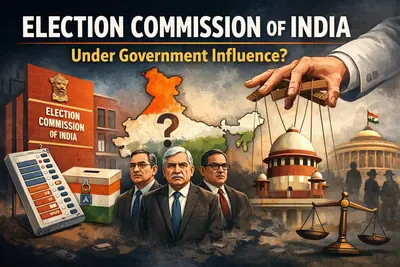
What’s Going on With the Election Commission?
The Election Commission of India (ECI) has been under a lot of scrutiny recently, both from the public and politicians. This heightened scrutiny comes after the Special Intensive Revision (SIR) of electoral rolls in the state of Bihar and similar discussions or proposals for SIRs in several other states.
Many people in Bihar are concerned because:
- There may be a potential risk that legitimate citizens will be excluded from voting.
- Voters may have to face increased administrative pressure to prove that they are eligible to vote.
- These types of changes may disproportionately impact migrants, the poor, and marginalized groups/communities.
Political opposition groups and members of civil society have criticized the timing, transparency, and intentions regarding such revisions, asserting that while it is necessary to “clean” (i.e., make accurate) electoral rolls, it is not acceptable to do so in a manner that undermines the principle of universal adult suffrage.
On top of this, the concern over the Central Government’s greater role in selecting Election Commissioners is also growing. This concern grew particularly after the Supreme Court of India made recent observations regarding the need for independent selection of Election Commissioners and after new legislation regarding the appointment of Election Commissioners changed the make-up of the selection committee.
Thus far, this has sparked a larger debate:
Is the Election Commission fulfilling its constitutional responsibilities (i.e., the continued existence of the Election Commission as an independent and impartial body), or is the Election Commission becoming progressively weaker due to the government’s increasing influence?
What Is the Election Commission of India?
The Election Commission of India (ECI) is a Constitutional Authority in India to oversee democratic elections in the largest democracy around the world.
Elections That Are Conducted by ECI
The ECI conducts elections to:
- Lok Sabha
- Rajya Sabha
- State Legislative Assemblies
- President and Vice President of India
Hence, The ECI also oversees the Voter Registration process; Polling Process; Counting of Votes, and Declaration of Results.
Constitutional Basis
Article 324 of the Constitution establishes the ECI’s parameters for authority.
Under Article 324, the ECI has three primary functions:
- Superintendence (oversight)
- Direction (to regulate)
- Control (Regulation of the electoral process).
Given the broad scope of this constitutional authority, the ECI is one of the most powerful completely Independent Institutions in India.
Therefore, based on the historical development of the ECI’s structure:
Composition of Election Commission of India
Initially, the ECI was composed of one member, the Chief Election Commissioner (CEC). The President had the authority under Article 324 to appoint additional Election Commissioners if he or she so desired.
- In 1989, two Election Commissioners were created, formally establishing the ECI as a multi-member body.
- In 1990, the ECI briefly reverted to a one-member body.
- In 1993, additional two Election Commissioners were created again. From then on, the ECI has remained a multi-member body.
At present, there are
- A Chief Election Commissioner (CEC) who acts as Chairperson
- Two Election Commissioners (EC)
- Regional Commissioners, if needed, appointed by the President of India.
The Commission makes decisions collectively.
Tenure & Conditions of Service
The tenure and conditions of service of CEC & ECs are determined under Law made by Parliament.
Key provisions are:
- Tenure: 6 years or 65 years (whichever is earlier)
- Decision-Making: In case of difference of opinion, decisions are taken by majority.
- Status & Pay: Same as Judge of the Supreme Court of India.
Although the law provides for equal pay and equal tenure, it is uncertain if legal equality translates into institutional independence.
Appointment Process: Where the Controversy Lies
The appointment of Election Commissioners has been a focal point of controversy relating to the independence of the Election Commission. While the Constitution establishes the Election Commission of India (ECI), it does not discuss how to appoint Election Commissioners. Therefore, the appointment of Election Commissioners could be influenced by the executive branch.
Old Practice
For many years, the process of appointing members of the Election Commission was as follows:
- By the President of India
- On the advice of the Central Government
There was no:
- Collegium
- Representation from the Opposition.
Therefore, The executive had a complete monopoly on all her appointments to the board that administered elections in which the executive herself ran.
The Supreme Court Case (2023): The Anoop Baranwal case
The Supreme Court stepped in during the historical matter of Anoop Baranwal v. Union of India (2023) to maintain the autonomy of the Election Commission.
Orders from the Supreme Court
Until Parliament enacts a law, the Supreme Court ordered that the appointment of Election Commissioners be made through a committee composed of:
- Prime Minister
- Leader of the Opposition in Lok Sabha
- or, in case of absence of Leader of the Opposition, the largest Opposition party leader
- Chief Justice of India
Additional Protection
The Supreme Court also established that:
- The grounds for the removal of other Election Commissioners must be the same as those of the Chief Election Commissioner; and
- The conditions of service for other Election Commissioners after appointment should not be adversely changed from what was established when they were appointed.
The Supreme Court acknowledged that there is a Constitutional guarantee to the right to free and fair elections and as a consequence the Election Commission is insulated from interference by the executive.
Parliament Passed New Law
The Parliament subsequently passed the new law to regulate the appointment of Election Commissioners.
Selection Committee (New Law) → New Composition → Three Members
- The Prime Minister;
- The Union Minister [nominated by the PM];
- The Leader of the Opposition (LOP); -To now be established in law as having no Judicial Oversight over any Member of the Selection Committee.
- The Chief Justice of India has been removed from this role, effectively creating a Power Vacuum within the Selection Committee. Judicial Review and the Authority of the Supreme Court to provide Judicial Oversight are now rendered meaningless.
Is a Minister’s appointment in lieu of the Chief Justice of India creating an imbalance of power between the Executive and the Judiciary?
Responsibilities and Power of the Election Commission
The Election Commission of India enjoys extensive responsibilities and the authority to exercise its powers. As such, the Election Commission plays a key role within the Indian Constitution.
Responsibilities and Powers associated with Elections
- Conduct elections for the Parliament and State Legislature, and for the constitutional positions (President and Vice-President).
- Prepare and revise the Electoral Roll.
- Register Political Parties and set out guidelines for their regulation and conduct.
- Allocate Election Symbols to Registered Political Parties.
Oversight and Control Powers
- Enforce Compliance with the Model Code of Conduct for Elections.
- Issue Compulsory Directions to Political Parties and Candidates.
- Postponement/Cancellation of elections due to Violence and/or other Malpractice.
- Order for Re-Polling when the Integrity of an Election has been breached or is in jeopardy.
Directional Guidance and Advisory Role
- Provide Directional Guidance to the President or Governor regarding:
- Disqualification of Members of Parliament and State Legislative Assemblies.
- Whether an Election can be held under the administration of President’s Rule.
These Opinions of the Election Commission of India are binding on the Executive.
Independence of Election Commission
The independence of the Election Commission (ECI) is secured by constitutional provisions is as follows:
1, Chief Election Commissioner (CEC):
- Can only be removed if impeached like the Supreme Court.
- No changes to the CEC’s service conditions can be made after appointment that are disadvantageous.
2. Other Election Commissioners and Regional Election Commissioners (REC):
- May only be removed from service by the endorsement of the CEC.
- As such, these provisions prevent executive interference.
However, significant structural weaknesses and grey areas exist despite these protections.
For example, the other Election Commissioners do not enjoy the same protection from removal as the Chief Election Commissioner does. The ability of others to be removed as a result of the recommendation of the CEC creates an internal hierarchy which would be having pressure on all of the Commissioners, including the CEC.
There are other structural weaknesses that exist within the Constitution, including:
- No qualification requirements are set forth in the Constitution for Election Commissioners.
- No appointment process is outlined in the Constitution.
- The Constitution does not address the future employment of retiring Election Commissioners within the Government.
- The terms and conditions of Election Commissioners are governed primarily by the law of Parliament, which the ruling party has control over.
- These weaknesses create apprehension that while legal independence exists, there may be a lack of operational independence.
Globally, there are other countries that face similar issues regarding independent election management. A brief global overview of different institutional safeguards shows how various democracies provide protection against political interference.
Comparison with other Country’s Election body
United States
The United States has established a Federal Election Commission for federal elections. Having equal representation of major political parties prevents a single party from taking unilateral control of elections, requiring consensus for the making of decisions and limiting the use of partisan advantage.
United Kingdom
The UK Electoral Commission is appointed through the same process by which Parliament appoints its members, thus maintaining legislative oversight and independence from the Executive. The UK’s Election Commission is considered a sufficiently independent body due to the accountability and transparency of its operations, but some would argue that Parliament’s appointment process is sufficient to ensure that political parties cannot dominate the executive’s decision-making.
South Africa
In South Africa, judicial and parliamentary oversight of the appointment process is implemented. Independent screening panels consider all candidates nominated for appointment prior to appointment by Parliament and ensures that the body is not subject to pressure from political parties.
In both cases, while there is executive involvement in the appointment of commission members, it is clear that the design of the respective institutions ensures that there is no dominance by the executive.
Way Forward
The independence of the ECI is vital for the legitimacy of the democratic process in India. If the public does not trust the electoral process, it will have no faith in the electoral outcomes. If the public perceives that the ECI is biased, they will take less notice of the ECI and will have less confidence in election results.
This perception will create greater political division, and it will erode the democratic legitimacy of the elections, even if the elections were conducted lawfully.
In order for a country such as India (which is vast and diverse with many different languages and cultures) to have an independent ECI, an independent ECI must serve as the custodian of the people’s mandate.
- Equal Protection from Removal for All Election Commissioners.
- Parliamentary Oversight Provides Accountability to the Public, Not to the Executive Branch.
- Reforms Should Bolster the Institutional Integrity of the Election Commission Regardless of Which Government Is in Power.
The Conclusion Is: Who Will Be the Watchdog of the Watchdogs?
The Election Commission of India Has Been the Cornerstone of Indian Democracy for Many Years—It Has Conducted Elections in Every Part of India, with Its Many Cultures, Languages, and Creeds.
As All Agencies, Including the Election Commission of India, Are Subjected to Changes Over Time, Institutions Must Refresh Their Credibility in Order to Survive as Democratic Entities. Independence Is Not a Constitutional Proclamation; It Is a Function of Public Trust and How an Agency Is Structured.
Therefore, the Key Question Is Not the Power That the Election Commission Holds, but If the Agency Is Free to Exercise That Power Without a Fear of Repercussions Due to Partisanship.
Every Democracy Exists and Survives Through the Institutions Created to Protect the Vote of Its Citizens.