UPSC

Nobel Prize 2025: Lessons for India’s Fight Against Air Pollution

Introduction Once again, the air quality in Delhi has become dangerously toxic. For years, bans and campaigns to improve air quality have been unsuccessful, as the city’s winter smog continues to push the Air Quality Index (AQI) beyond 400 (“very poor” or “severe”) and put public health at serious risk. This year was no different, […]

Nobel Prize 2025: Lessons for India’s Fight Against Air Pollution Read More »

Cultural and educational rights

T.M.A. Pai to AMU: Evolution of Cultural and Educational Rights in India

India: A Mosaic of Identities “Our Constitution doesn’t merely protect the voice of the majority. It protects the music of every smaller note in the great symphony of India.”— Justice D.Y. Chandrachud, Chief Justice of India India is not simply a nation, it is a civilizational mosaic, a glorious tapestry made of thousands of languages,

T.M.A. Pai to AMU: Evolution of Cultural and Educational Rights in India Read More »

Article 21 of the Indian constitution

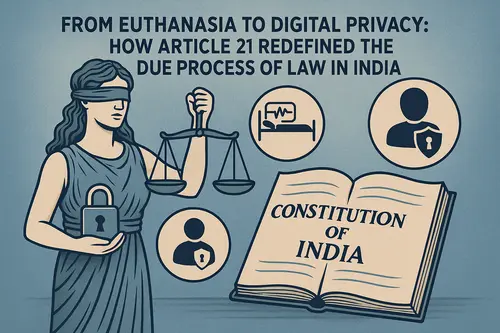
Article 21 of the Indian constitution: Euthanasia, Privacy, and the Due Process of Law

Introduction: The Heart of the Constitution Dr. B. R. Ambedkar referred to Article 21 as the “heart of the Constitution,” which is a living provision that infuses life into the entire structure of Fundamental Rights. Article 21 is the most interpreted and judicially expanded article in Indian jurisprudence and affects every dimension of human existence,

Article 21 of the Indian constitution: Euthanasia, Privacy, and the Due Process of Law Read More »

Article 20 of the Indian Constitution

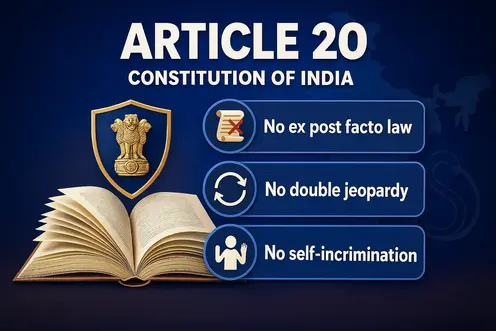
Article 20 of the Indian Constitution: Shielding Justice through Due Process

Introduction: ARTICLE 20 of the Indian Constitution “It is better that ten guilty persons escape than that one innocent suffer.” — William Blackstone No legal principle better captures the spirit of justice in this way. The idea that fairness must be uppermost to retribution captures the spirit of Article 20 of the Constitution of India.

Article 20 of the Indian Constitution: Shielding Justice through Due Process Read More »

Freedom of Speech & Expression

Freedom of Speech & Expression – Power, Limits, and the Changing Digital Reality

Introduction Citizens exercise free expression to render their government accountable, to inform citizens, and to participate as actors in the process of nation-building. Article 19(1)(a) of the Indian Constitution provides free expression to every citizen so that every citizen can express opinions in whatever format – written, verbal, visual, audio, online or digital interactive (regrettably,

Freedom of Speech & Expression – Power, Limits, and the Changing Digital Reality Read More »

Scroll to Top