October 2025

Writ Jurisdiction

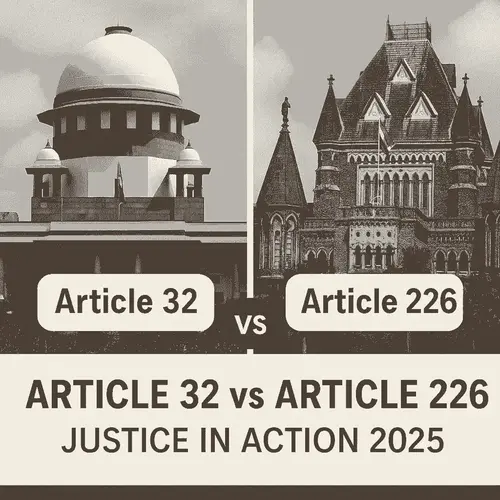
Writ Jurisdiction of SC & HC in Indian Constitution: Comparative analysis

Introduction Dr. B.R. Ambedkar famously referred to Article 32 as the “heart and soul of the Constitution.” This article enables citizens to approach the Supreme Court directly for the enforcement of Rights contained in Part III of the Constitution known as Fundamental Rights. Similarly, Article 226 of the Constitution empowers citizens to approach the High […]

Writ Jurisdiction of SC & HC in Indian Constitution: Comparative analysis Read More »
Articles 31A, 31B, and 31C

Articles 31A, 31B, and 31C: Balancing Property Rights, Socialism, and Judicial Review in India

Introduction “The fundamental rights must harmonize with the directive principles — for liberty without equality can be hollow, and property without justice can be tyranny.”— Jawaharlal Nehru, during debates on the First Constitutional Amendment, 1951 When enacted, the Indian Constitution gave the Right to Property as a Fundamental Right, under Articles 19(1)(f) and 31, ensuring

Articles 31A, 31B, and 31C: Balancing Property Rights, Socialism, and Judicial Review in India Read More »

Nobel Prize 2025: Lessons for India’s Fight Against Air Pollution

Introduction Once again, the air quality in Delhi has become dangerously toxic. For years, bans and campaigns to improve air quality have been unsuccessful, as the city’s winter smog continues to push the Air Quality Index (AQI) beyond 400 (“very poor” or “severe”) and put public health at serious risk. This year was no different,

Nobel Prize 2025: Lessons for India’s Fight Against Air Pollution Read More »

Cultural and educational rights

T.M.A. Pai to AMU: Evolution of Cultural and Educational Rights in India

India: A Mosaic of Identities “Our Constitution doesn’t merely protect the voice of the majority. It protects the music of every smaller note in the great symphony of India.”— Justice D.Y. Chandrachud, Chief Justice of India India is not simply a nation, it is a civilizational mosaic, a glorious tapestry made of thousands of languages,

T.M.A. Pai to AMU: Evolution of Cultural and Educational Rights in India Read More »

Freedom of Religion

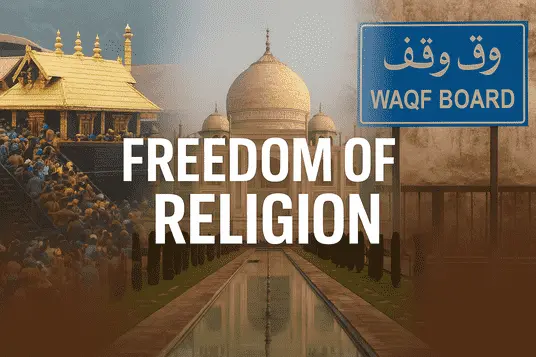
Freedom of Religion in India: Sabarimala, Waqf Board, and Constitutional Insights

In a country of a thousand different faiths, the Constitution of India serves as the only strand that weaves them together. Whether it is the case on whether women can enter the Sabarimala temple, the Waqf Board property cases, or the recent film claims regarding “The Taj Story” about the Taj Mahal having once served

Freedom of Religion in India: Sabarimala, Waqf Board, and Constitutional Insights Read More »

Scroll to Top